

Mehr

22.01.2020: "Grund und Boden – highly estimated. The floor estimate in the Oberpfalz – from analog to digital" - exhibition at the Staatsarchiv Amberg
Wednesday, 22. January 2020, the small exhibition “Grund und Boden – was highly appreciated in the Amberg State Archive. The soil estimate in the Oberpfalz – from analog to digital” opens. The exhibition is a cooperation project of the Amberg State Archives with the Office for Digitization, Broadband and Survey Amberg and the Weiden Finance Office. What is a field or a meadow worth? What's the ground? How do climate and water conditions shape? Answers to these questions arise from the soil estimate. The soil estimate is an inventory of agricultural soils according to the nature of their use and their natural viability. It is used to tax agricultural assets, but it is also important as a basis for determining value in land transport and rural development, land protection and land information systems. The exhibition with about 60 exhibits traces the history of soil estimation from its beginnings in the 1930s to the present and presents its organization and execution yesterday and today. Estimation cards and estimates books, which have only recently been submitted to the Amberg State Archive, documents, practical instructions, photos, technical equipment and soil samples, are shown. A fair distribution of the loads according to ownership and economic power has always been a reason for the tax on land and land. In addition, the exhibition therefore illustrates the prehistory: possessions and tax books from the Middle Ages and early modern times as well as cataster documents from the 19th century. Centuries give an insight into the tax assessment before the soil estimate. Hand-drawn cards from the 17th and 18th Century conveys an optical impression of landscapes in pre-industrial time. In addition to the documentation of the estimation results on paper, the modern digital mode of operation of the soil estimate is explained and the processing of the geodata in ALKIS as well as its evaluation possibilities via the Geoportal Bayern is demonstrated. This means that the floor estimate is not only placed in the larger frames of the history of the tax system, but also a sheet is beaten by the analogue to the digital geodata management. The implementation of the soil estimate is the task of the financial authorities which collect the results in estimation cards and estimation books and forward them to the survey management. This is responsible for the continuation of the digital data stock in ALKIS (Automatized Property Cataster Information System) and for the distribution of the data. The exhibition is from 22. January 2020 to 28 February 2020 in the State Archive Amberg, Archivstraße 3, 92224 Amberg (Input Weißenburger Straße) to see. Opening hours: Monday and Thursday 8:00 to 16:00, Tuesday and Wednesday 8:00 to 18:00, Friday 8:00 to 13:30 (Sa, So closed, Carnival Serviceag 25.2. open only until 12:00) Free admission. Guided tours for groups can be under 09621/307-911 or poststelle@staam.bayern.de to be agreed. Submitted on: 22.01.2020 Related files: Pressemitteilung

19.11.2019: "Naturschutz in Bayern vor 1979 - Actions and actors" - Lehrausstellung im Bayerischer Hauptstaatsarchiv
On Tuesday, 19 November 2019, the small exhibition "Naturschutz in Bayern" will be held in the Bavarian Main State Archive before 1979. Actions and actors’. The exhibition was opened in the course of training in the preparation service 2017/2020 for the entry into the 3rd Qualification level of the field of education and science, specialist focus on archives, at the University of Applied Sciences in Bavaria, elaborated by Andrea Kurzböck. Climate protection and environmental protection are currently dominated by public discussion, and nature conservation is rarely discussed. An exception is species protection, a core area of nature protection. Since 19. In addition to species protection, nature protectors are concerned with the protection of the landscape and individual natural monuments. Procedures, personnel structure and motivations of nature conservation have been subject to changes over time, but have always been diverse. State and non-governmental institutions demanded, appealed to reason and emotions, mobilized, threatened with punishment, rewarded but also exemplary action. Associations, associations, press and state authorities gathered and disseminated information. At the beginning, aesthetic and patriotic-conservative aspects were at the centre of the argumentation. Other motives were the protection of nature for scientific purposes and the recognition that the destruction of nature is burdening the economy in the long term. Ecological and social argumentation lines were added early on with the idea of sustainability. With 31 exhibits in 6 sections, the small exhibition shows some central ways of nature conservation until 1979. As a trader, it presents large institutions such as the Confederation of Nature Conservation and State Ministries as well as smaller associations and municipal institutions. In addition, she gives insights into the various motivations for nature conservation efforts. The time frame is derived from the re-establishment of an environmental party in Bavaria, which also committed to nature conservation in its programme and thus gave the discussion a new component at political level. The exhibition can be seen from 19 November 2019 until 10 January 2020 in the main building of the Bavarian Main State Archive (Treppenhaus, 1st OG), Schönfeldstraße 5, 80539 Munich. Opening hours: Monday to Thursday 8.30–18.00 hrs., Friday 8.30–13.30 hrs. (Sa, So and from 23.12.2019 to 6.1.2020 closed) Free admission. Guided tours for groups can be agreed under (089) 28638-2575. Further information www.gda.bayern.de (press images can be requested in higher resolution). Online conditions for nature protection (selection): °C Bavarian State Archive, German Forest Protection Community °C Bayerisches Hauptstaatsarchiv, Landesstelle für Naturschutz °C Bayerischer Hauptstaatsarchiv, Ministry of Food, Agriculture and Forestry: MELF 4 (Forstwesen) °C Bavarian State Archive, Ministry of Finance: MF 22 Forestry °C Bavarian State Archive, Ministry of Culture: MK 3/1 (with Digitalisat zum Exponat 1a: MK 14649) °C Staatsarchiv München, Bezirksamt/Landratsamt Laufen Related files: Pressemitteilung

21.01.2020: Bavaria and Poland in the first half of 20. Century. Strokes on an alternating relationship
Tuesday, 21. January 2020, the small exhibition “Bayern and Poland” was held in the first half of the 20th century in the Bavarian State Archives Directorate-General. Century. Opened to an interchangeable relationship. The exhibition was opened in the course of training in the preparatory service 2018/2020 for the entry into the 4th Qualification level of the field of education and science, specialist focus on archives, at the Bavarian Archive School. Dr. Katharina Aubele, Dr. Julia Oberst and Dr. Hubert Seliger are responsible for the exhibition. In addition to their position in the middle of Europe, Bavaria and Poland have two particularities: both countries have undergone a change in state development and both have not been seldom playing ball of the Great Powers In addition, in the first half of the 20. numerous connections and interfaces between Bavaria and Poland, which are illuminated in more detail in the small exhibition. Despite the rather light-like approach, attempts are being made to remember forgotten aspects of common, also pan-European history. In addition to basic questions about who was Pole from the Bavarian perspective and how the diplomatic relations between Bavaria and Poland and the Polish Consulate General in Munich developed, the exhibition follows the traces of Polish students in Bavaria. What Polish associations and student connections were there? Why had Bavarian universities at the beginning of the 20th century A century of attraction to Polish students? The voltage fields of the first half of the 20. During the First World War, Poland in Bavaria was often mistrusted “Ausländer”, later forced laborers subjected to the Nazi regime without protection, or displaced persons without home after the war. Art and culture reflect the alternating Polish-Bavarian relations in the first half of the 20th. The most famous example is the Landshuter Wedding, which has been celebrated regularly since 1903 and which, although taking up a historical event, should attract foreign guests to Landshut. The Polish art and also the artist Veit Shock (1447/1448–1533) were subject to significant struggles, claiming Nuremberg and Krakow equally. In Bavarian archives and libraries, the versatile and diverse Bavarian-Polish relationship can be traced. The tradition of the Bavarian ministries stored in the Bavarian Main State Archives as well as the tradition of the sub- and central authorities and the courts in the state archives should be highlighted. Further documents can be found in ecclesiastical and university archives. For example, the small exhibition combines about 40 exhibits from the Bavarian Main State Archives, the State Archives Augsburg and Munich, the Archive of the Archdiocese of Munich and Freising, the City Archive Munich and the Bayerische Staatsbibliothek. The exhibition is from 21. January 2020 until 7 March 2020 in the main building of the Bavarian Main State Archive (Treppenhaus, 1st OG), Schönfeldstraße 5, 80539 Munich to see. Opening hours: Monday to Thursday 8.30–18.00, Friday 8.30–13.30 (Sa, So and at the Carnival Serviceag 25.2.2020 closed; Special opening on the Tag Archives, Sa 7.3.2020) Free admission. Guided tours for groups can be agreed under (089) 28638-2575. Further information at www.gda.bayern.de (press images in higher resolution can be requested). To the exhibition a small Exhibition catalogue. Submitted on: 21.01.2020 Related files: Pressemitteilung Bild 3a: Reklamemarke mit Motiven der Landshuter Hochzeit, 1913, Privatbesitz (Foto: Bayerisches Hauptstaatsarchiv) Bild 3b: Reklamemarke mit Motiven der Landshuter Hochzeit, 1913, Privatbesitz (Fotos: Bayerisches Hauptstaatsarchiv). Bild 3d: Reklamemarke mit Motiven der Landshuter Hochzeit, 1913, Privatbesitz (Fotos: Bayerisches Hauptstaatsarchiv) Bild 3e: Reklamemarke mit Motiven der Landshuter Hochzeit, 1913, Privatbesitz (Foto: Bayerisches Hauptstaatsarchiv)

30.10.2019: Vorlass Barbara Stamm secured for the future in the Bavarian Main State Archive
The Bayerische Hauptstaatsarchiv takes over the written prelude of Barbara Stamm (CSU), which on 29 October is its 75th. celebrated birthday. The well-known national politician worked for more than four decades (1976–2018) as a member of the Bavarian Landtag. She was a State Secretary, Minister of State and Deputy Prime Minister among several Bavarian Prime Minister. She last met as President of the State until 2018. It not only holds the record as one of the longest-served Members in a German parliament, but is also a first-class witness to Bavarian national politics since the times of Franz Josef Strauss. Large parts of the politician's archival decree have already been transferred to the Bavarian Main State Archive. There, the documents are ordered, collected in terms of content and protected in a conservative manner. After the expiry of the protection periods laid down in the Archives Act, the material of research is available as an authentic source. The private writing of the well-known and popular politician includes, in addition to relevant documents, unusually many signatures by citizens, as well as by fellow politicians and companions. This enables the assessment of their political achievements from the perspective of contemporaries. Since Barbara Stamm is also known as a friend of the Franconian fast night, a series of carnival orders, carnival caps and certificates on fast night awards can be found in her lecture. Submitted on: 30.10.2019 Related files: Pressemitteilung

06.-10.03.2020: 10th national day of archives from 6 to 10. March 2020 under the motto "Communication. From depesche to tweet"
Every two years, the Association of German Archivists (VdA) calls for the "Tag der Archive". There are numerous public and private archives, open their magazines and present their work and stocks. This year the action day is under motto "Communication. From depesche to tweet". It takes place at the beginning of March, mainly at Weekend 7./8. March 2020. The state archives of Bavaria also work on the action day. The Bavarian State Archive (Saturday March 7) and the state archives Amberg (Saturday 7 March), Bamberg (Friday 6 March), Coburg (Monday 9 March), Country hat (Monday 9 March and Tuesday 10. March) and Munich (Saturday March 7) open their doors. The State Archive Würzburg is involved in the joint action day of the Würzburg Archives in the archive and library of the Diocese of Würzburg (Domerschulstr. 7) (Friday 6 March). Lectures, exhibitions and guided tours are offered. Bavarian State Archive - Yeah. Saturday, 7 March 2020, 10.00-17.00 as guest: Archive of the Bavarian Academy of Sciences as guest: Stenographer-Zentralverein Gabelsberger e. V. in Munich State Archive Amberg - Yeah. Saturday, 7 March 2020, 10.00-14.00 State Archive Bamberg - Yeah. Friday, 6. March 2020, 16.00-17.30 State Archive Coburg - Yeah. Monday, 9. March 2020, 18.30 - 20.00 am State Archive Landshut - Yeah. Monday, 9 March 2020 and Tuesday, 10. March 2020 - 16.00 each State Archive Munich - Yeah. Saturday, 7 March 2020, 12.00-19.00 State Archive Würzburg - Yeah. Friday, 6. March 2020, , 14.00 - 19.00 The Staatsarchiv Augsburg takes part in "Augsburg Open" at the end of March together with other Augsburg facilities (https://www.augsburg-city.de/veranstaltungen/augsburg-open). All events on the day of archives, including in other cities and in municipal, ecclesiastical, economic, party and university archives as well as archives of other scientific institutions, can be found on the page https://www.tagderarchive.de/ information. The Bavarian State Ministry of Science and Art has a Press release to the planned events in the state archives. Submitted on: 06.02.2020, added on: 02.03.2020 Related files: Pressemitteilung zum Tag der Archive 2020
30.04.2019: NEW COLLECTION: “Description of Estates in the Bavarian Main State Archive”
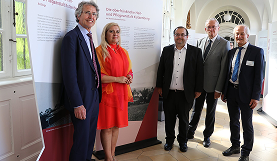
Written discounts of individuals are of considerable importance for the cultural memory of the state or society. They complement the official tradition and provide a view of history from a personal perspective. This is why archives and other memory institutions are intensively concerned with the preservation, development and use of these private sources. The Bayerische Hauptstaatsarchiv keeps estates of important personalities and collections in its own department, such as leaflets, posters, photos, and association articles. 30. April 2019 was presented to the public the new “Directory of Estates in the Bavarian Main State Archive” in the presence of Mr. State Minister for Science and Art Bernd Sibler, MdL. Art and Science Minister Bernd Sibler, a self-studied historian, stressed in the run-up to the event: “Public estates are valuable cultural evidence of our country. They help to better understand the work and work of important personalities and are thus a unique source of historical research. I am proud that the archive inventory on estates in the Bayerischer Hauptstaatsarchiv facilitates access to this high cultural property for all interested and makes us aware again: archives are the memory of our country!” Through its clear structure, the inventory provides a quick overview of these sources that are so important for historical research. Which life stations of the estate agents can be traced? Who corresponded to who? Where can I find other parts of the estate? Biographical basic data, data on the duration and extent, as well as brief information on the content of the most written documents forming the estate, open up an exciting network, which also invites you to cross-read. The estates come from important families and personalities from Bavarian politics and history. Maximilian von Montgelas, Princess Therese von Bayern, Willi Graf, Christoph Probst, Hans Ehard, Mathilde Berghofer-Weichner and Max StÃ1⁄4hl are some examples of estate agents from Bavaria. The estates from the Sudeten German Archive, which is deposited in the Bavarian Main State Archive, constitute a not inconsiderable part. The printing of the tape was generously Association Friends and Sponsors of the Bayerischer Hauptstaatsarchiv and of the Sudetendeutsche Institut e.V. support. orders about the book trade; Direct sale: Bayerisches Hauptstaatsarchiv, Schönfeldstraße 5, 80539 Munich; Price 25,00 € (plus postage and packaging) A large part of the discounts summarized in the archive inventory can be searched as an online finder on the homepage of the Bavarian State Archives: °C Bavarian State Archive5 Department V: Estates and Collections, 5.1 Estates and Family Archives) Digitalisate is also available for research for the estate of Maximilian Graf von Montgelas: °C Online digitalisate for the estate of Maximilian from Montgelas

21.10.2019: #Ostarrichi certificate: The journey to Vienna begins...
Before leaving Munich, Margit Ksoll-Marcon, Director-General of the State Archives, as well as Bernhard Grau, Director of the Main State Archives, embark on the origin and history of the approximately 1000 year old document and describe his way to the Bayerische Hauptstaatsarchiv. Monika Sommer, Director of the House of History Austria, gives a preview of the presentation of the document in Vienna. This will be seen for the first time in Austria for over two decades and for the first time in Vienna. She will be under the title #Ostarrichi. The career of a document of 26.10.–3.11.2019. On 26 October the hdgö invites all interested parties to the new castle at the Wiener Heldenplatz. Bernd Sibler, Bavarian Minister of State for Science and Art, is pleased to see that it is possible to borrow the document for a week to Vienna: “With the borrowing of the frequently asked “Ostarrichi-degree‛, the Free State of Bavaria takes into account the great importance that this document holds for the Republic of Austria and its citizens. We also understand this as a sign of good neighbourly relations that have their roots in a long common history and tradition. ‘ “Original sources offer a fascinating insight into our history and make them experienceable for people. I am pleased that one of the most important documents of our history – which is known to many from the school books – can now be seen in Vienna for a short time. My thanks to the House of History of Austria for the initiative and the Bavarian Main State Archive for Cooperation,” says the Austrian Federal Minister for EU, Art, Culture and Media, Alexander Schallenberg. Dr. Margit Ksoll-Marcon, Director-General of the State Archives in Bavaria, underlines the special contrast to the House of History of Austria: “The “Ostarrichi-Urkunde‛ is one of the most prominent pieces from the extensive, diverse and supraregionally significant archives of the Bavarian Main State Archives. The exhibition of such over 1000 years old parchment certificate places the highest demands on transport and presentation. The fact that the document can be shown for the first time in the Austrian capital fulfils me with pride and joy. ‘ Dr. Bernhard Grau explains how a document that has such a fundamental significance for the history of Austria has come into the holdings of the Bavarian Main State Archive: “The fact that the “Ostarrichi Certificate” is now stored in the Bavarian Main State Archive is not a coincidence but has to do with the legal business held therein. Emperor Otto III, with this document, passed over to the Bishop of Freising property in the space of Neuhofen an der Ybbs in today's Lower Austria. The Hochstift Freising was therefore the recipient of the document and had kept it in its archive over the centuries. At the beginning of the 19th century it served as proof of the legal claims covered by it. Only through secularization was this property lost. At the same time, the Kurfürstentum Bayern took over large parts of the Freisinger Archive, in particular all those documents relating to the rights of rule and court, as well as relations with foreign states. Thus, the “Ostarrichi-Urkunde‛ also came into the power of the central archives of the Kurfürlich, then Royal Bavarian. ‘ To present the document in the House of History Austria in Vienna says Dr. Monika Sommer, Director of the House of History Austria: “After World War II, the “Ostarrichi-deed” took an important role in the search for a new Austrian identity. We show the precious document for the first time under this aspect and for the first time in Vienna. An ideal time for small and large to discover this unique historical document and its significance for the history of our country. Entrance is free on the Austrian National Day on 26 October.” Origin, content and meaning of the ‘Ostarrichi’ certificate On November 1, 996, Emperor Otto III transferred his residence to the Bishop of Freisinger. As proof of these titles, the document was kept in the archive of the Hochstifts Freising for centuries. In the course of secularization, she came into state possession. Today it becomes under the signature Hochstift Freising certificates 14 stored in the Bavarian State Archive in Munich. The document is the oldest known document in which the geographical name “ostarrîchi” – the old high-German form of the later Austrian state name – is used as the name of the Austrian territory today. Austria celebrates itself In the House of History Austria, the use of the document for identity policy purposes in the Second Republic is discussed. In order to form a new “Austrian identity” on the way to regain sovereignty after the end of World War II in 1945, the young Second Republic sought reference points in history. Thus the “Ostarrichi” document became an argument for the long history of the Austrian nation. An “Ostarrichi” anniversary was celebrated for the first time on 950. Anniversary of the exhibition of the document in 1946. The celebrations that were supposed to be the starting point of a new power wave in reconstruction were explored by the then Minister of Education Felix Hurdes. In response to his initiative, the “950 Years of Austria” project was launched for the autumn of 1946 in order to “train young people to Austrian consciousness and to respect the glorious past of the fatherland”. Sunday, 29th September 1946, an “Ostarrichi-Staffel” brought a copy of the “Ostarrichi-deed” from Neuhofen at Ybbs to Vienna. In 1976, the “Ostarrichi-Urkunde” at the exhibition “1000 Years Babenberger in Austria” in Lilienfeld was the first to be seen in the original. A second time, 20 years later, the document in 1996 was the focus of great celebrations on “1000 years of Austria”. The Austrian National Exhibition took the year 996 as the starting point for an intensive discussion with Austria, its name and its history. Overview of the changing history of the “Ostarrichi” 1. November 996 On his return journey from Rome the freshly crowned Emperor Otto III makes. (983–1002) in Bruchsal am Oberrhein stop. With the document issued there on Bitten Herzog Heinrich's IV by Bavaria, he transfers the property to Freisinger Bischof Gottschalk to a Fronhof and thirty royal yeasts in the area of Neuhofen an der Ybbs. This region was part of the Duchy of Bavaria at that time. The document also mentions the situation of these goods in the domain of Babenberger Markgrafen, Heinrich I. A legal transaction like this is anything but unusual for the Middle Ages. The amount of donation, which meant a significant increase in ownership for the Hochstift Freising, is at most remarkable. Today you are convinced that the document has not been created and completed in one step. Rather, it is assumed that the firm of the emperor initially only wrote the final part of the document (Eschatokoll), i.e. the sign or signature line with the monogram, the cognition line in which the name of the Chancellor responsible for the execution, of the Bishop Hildibald, is called, and the dating. On the other hand, the input protocol, but above all the context, i.e. the content of law in the narrower sense, comes from the hand of a Freisinger Schreiber. Such a procedure, especially in the case of the Freisinger Church, was not unusual and therefore even considered an indication of the authenticity of the document. 1893 The historian Theodor Sickel, who edits the document in the Monumenta Germaniae Historica (MGH), describes the document as a “diplom of doubtful validity”. “Diplomatic inconsistencies” he recognizes above all in relation to the seal. The seal, which was still loosely attached to the document at Sickel's time, was not from the Exhibitor Emperor Otto III, but from his successor, King and later Emperor Henry II. This seal is lost today. His absence was observed in 1911. The only picture can be found at the Freisinger historian Carolus Meichelbeck, who published a drawing of the seal image in 1724. The use of the Royal Seal of Heinrich II gives many questions to research. Nevertheless, the authenticity of the document is out of doubt for today's researchers. It is merely discussed whether the document was first sealed under Heinrich II and thus completed or whether the seal of Emperor Otto III was lost over time and was therefore improperly replaced by another seal. 1946 ‘Action 950 years Austria’ After the end of the Second World War and the Nazi period, Austria is looking for images from the further past to build its national identity and to regain its sovereignty. Representatives from the ÖVP's series with Minister of Education Felix Hurdes at the top are committed to the idea of taking the document Emperor Otto's official occasion for an Austrian anniversary. Well-known scientists deal with the document, at federal, state and community level. In the weeks before 1 November, various institutions, traditional associations and sports associations organize festive events and commemorative days. Representatives of the parties are committed to the “Nation Österreich” in delimitation to Germany and try to find historical arguments for the character of the Austrians’ own type. Especially children and young people should be given an Austrian awareness. They were therefore special addressees of the 950 year filings. 1976 „Ostarrichi-Urkunde“ for the first time in Austria In Lilienfeld, another big anniversary is celebrated: “1000 years Babenberger”. The national exhibition tells about the Babenbergerherrschaft, which took its exit in 976 in the “Mark an der Donau”. As part of this exhibition, the “Ostarrichi-Urkunde” will be shown for the first time in Austria. 1980 Another anniversary In 1946, the town of Neuhofen at Ybbs had already experienced state-political importance: The festival at the “historical site” became the central event of official celebrations. Among other things, Chancellor Leopold Figl had revealed the “Ostarrîchi Memorial Stone”. In 1980, Neuhofen is once again becoming a national memorial: on the occasion of 975. The “Ostarrîchi Memorial” is opened again, with the participation of the federal government, countries and the municipality. On May 10, the “Austria Festival” will be celebrated, taking into account “25 years of Austrian State Contract”. It speaks the Federal President Rudolf Kirchschläger, the original document remains in the archive in Munich. 1996 The Millennium When designing the celebrations on the occasion of “1000 years of Ostarrichi”, the 50 years of previously produced collective images and remembrance sites can be used. The Austrian National Exhibition takes place at the Ybbs in Neuhofen, where its aim is “a critical and loving confrontation of visitors with “Austria” (...). The ‘Ostarrichi’ certificate is issued and is once again subject to historical research. 2019 „Ostarrichi-Urkunde“ for the first time in Vienna The House of History of Austria places the original document in the center of historical identity formation processes and discussions. By presenting the “Ostarrichi” document shortly before the first birthday of the House of History of Austria in the Hofburg, the museum itself moves in the field of science, history politics and the public. All information about the program of the House of History Austria and press photos can be found on the following link: https://www.hdgoe.at/category/press For further information on the document and the findings obtained from scientific research, please see the following websites: https://de.wikipedia.org/wiki/Ostarrichi http://www.noe.gv.at/noe/Historical Landeskunde/Ostarrichi-Urkunde.html http://members.chello.at/heinz.pohl/Ostarrichi_996.htm https://www.hdgoe.at/ostarrichi Submitted on: 21.10.2019 Related files: Gemeinsame Pressemitteilung des Bayerischen Hauptstaatsarchivs und des Hauses der Geschichte Österreich

27.6.2024: Emergency association Bayern founded
Climate change promotes natural disasters and extreme weather conditions, the consequences of which increasingly affect cultural institutions. Flood 2024 again proves that such damage events are usually no longer possible at local level alone. A cross-border networked infrastructure for the protection of cultural property with appropriate personnel and technical equipment is becoming increasingly important. In order to be better prepared for major damage events in Bavaria, leading cultural institutions join the Bavarian emergency association. First sign of the agreement the Directorate-General of the State Archives of Bavaria the Bayerische Staatsbibliothek the state office for non-governmental museums in Bavaria the Bayerische Staatsgemäldesammlungen the Bavarian National Museum Archive and Library of the Archdiocese of Munich and Freising the archive of the archbishop Bamberg the Archaeological State Collection the Federal Archive for its facility Load balancing archive Bayreuth The Bavaria emergency association supplements the existing regional emergency alliances with a supra-regional level. So far, there are already active emergency alliances in Bavaria at the locations of all state archives, i.e. in Amberg-Sulzbach-Rosenberg, Augsburg, Bamberg, Coburg, Landshut, Munich, Nuremberg and Würzburg. Other local allies are found. Minister of State Markus Blume emphasised on the signing of the agreement: “Prevention, protection and networking are best achieved together: With the establishment of the Bavarian emergency association, cultural institutions from all over the Free State join forces to quickly and extensively protect our cultural treasures. At the heart of the composite is the provision and coordination of a special emergency container for the protection of cultural property. In emergency, expert experts from the association advise and accompany the fire brigade when using the container. Thus, hand-in-hand with the operational forces, a quick, safe and precise protection of our cultural treasures is guaranteed. ‘ In the event of a major damage event, the institutions, which are combined in the Bavarian emergency association, bundle their human, technical and technical resources in order to preserve irreplaceable cultural property from loss and destruction. The first 48 hours decide on the success of a first supply, after this time, mold formation is used in wet objects. Even after that, a recovery is still possible, but the more rapid action is done properly, the better. Objectives of the Bavarian emergency association are procurement and provision of required large equipment and regular training. In the event of damage, members of the association help with recovery and initial care, the subsequent further processing is not the task of the emergency network. For the Bavarian emergency association, as large as possible facilities should be obtained, which run their own workshops or regularly supervise their own large-scale projects in the field of conservation. In this way, the facilities have the necessary expertise in order to also initiate further operational forces in the appropriate handling of crops to be fermented or already havared. A broad distribution of competence was also central. In addition to archives and libraries, large museums are represented and an important competent representative of smaller museums is represented by the state office for non-governmental museums. Whether document, book, painting or sculpture, for any kind of cultural property are specialists on board. The Federal Government supports the 2021 regions affected by floods and heavy rain during the reconstruction and the cultural facilities located there in order to cope with damage. From the funds provided for this purpose, a total of ten emergency containers are purchased with equipment and materials for the protection of cultural goods and kept ready for nationwide use. The main objective of the 10 containers to be distributed over the federal territory is the creation of a networked emergency infrastructure cultural property protection, which can also be combined. For Bavaria is currently running Production of a special container according to the model of the unrolling container of the emergency composite Cologne which has already been proven in use. Starting in the middle of 2025, this roll-off container is ready for cultural goods protection at a logistically easily accessible location in the Munich area for the supra-regional retrieval via the emergency association Bayern. The alarming takes place via the control points of the fire department, the final decision as to whether there is an occasion for a request of the container, meets the emergency association Bayern. The emergency network also alerts the team of the container – tailored to the respective affected cultural goods. Further information: Emergency allies in Germany. The coordinating body for the preservation of the written cultural goods (KEK) takes into account the emergency provision in its funding lines and supports, for example, the purchase of emergency boxes and other equipment or the preparation of emergency plans. An overview of projects funded so far in the field of emergency provision is about KEK's homepage available. Also provided on the homepage of the KEK interactive overview map of all emergency alliances in Germany. The Security Guide Kulturgut (SiLK) offers archives, libraries and museums with a free online tool the possibility of Self-evaluation to raise the level of security of your own institution and to expose vulnerabilities. The joint recommendations for emergency management in archives and libraries of the federal state bodies were recast in 2024 and are here available. More information on conservation in the field Technical information on our homepage. BU 1: Signing of the agreement “Notfallverbund Bayern” on 27. June 2024 in the Directorate-General for State Archives of Bavaria. The group picture shows (from left to right): Dr. Dirk Blübaum and Simone Schön (both: Landesstelle für die Non-State Museums in Bavaria); Archivdirektor Karsten Kühnel M.A. (Federal Archives) Prof. Dr. Johannes Merz (Archive and Library of the Archdiocese of Munich and Freising); Eva Ortner M.A. (Doerner Institute/Bayerische Staatsgemäldesammlungen); Dr. Laura Scherr and Dr. Bernhard Grau (both: Directorate-General of the Bavarian State Archives); Dr. Rolf-Dieter Jungk (Amtschef in the Bavarian State Ministry of Science and Art); Prof. Dr. Bernhard Maaz (Bayerische Staatsgemäldesammlungen); Dr. Frank Matthias Kammel (Bayerisches Nationalmuseum); Prof. Dr. Rupert Gebhard (Archäologische Staatssammlung); Dr. Klaus Ceynowa (Bayerische Staatsbibliothek); Kreisbrandrat Johann Eitzenberger (chairman of the Landesfeuerwehrverband Bayern e.V.); Dipl.-Chem. Dipl.-Ing. (FH) Jürgen Schwarz (Bayerisches Staatsministerium des Innern, für Sport und Integration); Photo: Bayerisches Hauptstaatsarchiv. BU 2: Roll-off container Cultural property protection of the emergency network Cologne; Photo: City Archive Cologne. Created on 27.6.2024