
Mehr

Revolution and Räterepubliken in Bavaria 1918/19
100. Birthday of the Free State presented bavaricon the exciting and dramatic history of its beginnings in a virtual exhibition. Five chronological sections and a level of deepening bring you closer to the Revolutionary Years 1918/19. The focus is on the events in the capital Munich, which were decisive for all Bavaria. In addition, the various developments are included in ten other locations of Altbayerns, Frankens and Schwabens. 90 high-calibre exhibits from archives, libraries and museums show you the decisive changes and changes of this time – with all their breakthrough achievements, but also the problematic accompanying phenomena and consequences. Here you can visit the virtual exhibition!
![Exhibition poster [JPG file]](/mam/typo3/user_upload/Medien_fuer_Aktuelles/2021/plakat_ausstellung-judentum-regensburg_okt-2021.jpg)
Regensburg and his Jewish community in the Middle Ages
Tuesday, 26. October 2021, the new virtual exhibition “Regensburg and its Jewish community in the Middle Ages” was held in the Directorate-General of the State Archives of Bavaria. Cultural portal bavarikon open. At the ceremony, Minister of State Bernd Sibler, MdL, Dr. Ludwig Spaenle, Minister of State a.D., MdL, commissioner of the Bavarian State Government for Jewish life and against anti-Semitism, for remembrance and historical heritage as well as Ms. Ilse Danziger, Jewish Community Regensburg and Vice President of the State Association of the Jewish Communitys in Bavaria. Dr. Astrid Riedler-Pohlers, Bayerisches Hauptstaatsarchiv, who drew up the exhibition, introduced the virtual show and presented selected exhibits. About the link www.bavarikon.de/judentum-regensburg is the exhibition from the 26th October 2021. The event was broadcast via live stream. The project is a contribution of the Bavarian State Archives to the anniversary year 2021 Jewish life in Germany: https://2021jlid.de. The virtual exhibition tells the history of the Jews in the medieval Regensburg. What are the conditions for Jewish life in this important city? What relations existed between Jews and Christians? What professions did they practice and what social status did they have? As large as the number of sources is, so different are the topics they tell of. Certificates, seals, Hebrew manuscripts, pictures, maps, archaeological finds and other special pieces report from the Jewish Regensburgers. Digitalisate from the holdings of eleven cultural institutions allows to virtually take these unique sources and explore details. Six chapters show how the Jewish community of Regensburg has developed and why it is so important today. The Jewish quarter and its inhabitants are presented as well as their utility with everyday needs. Religi-on was the predominant element in the Middle Ages and this was also true for the Jewish community. What diverse activities Jews carried out, as they earned their living and to whom the Jewish community was in contact, are also exciting topics such as the rights and duties that Jews had in the medieval Regensburg. The Jewish community of Regensburg remained largely spared from the waves of persecution that the Jews of Europe were exposed to in the Middle Ages. At the time of her expulsion in 1519, she was able to look back on a more than 500-year history in the city, unlike most other Jewish communities. With over 60 exhibits in six sections, the virtual exhibition makes the medieval history of the Jewish community of Regensburg alive. All exhibits, including 3D digitalisates, which are accessible for the first time, are shown in outstanding digital quality. The exhibition is under www.bavarikon.de/judentum-regensburg. bavarikon is the website of art, culture and national history of the Free State of Bavaria (www.bavarikon.de). It makes Bavaria's diverse cultural heritage accessible worldwide free of charge and addresses both the broad culturally interested public and scientific users. Over 370 000 content of more than 110 cultural institutions is now online. bavarikon is a joint project of the Ministry of State for Science and Art and the Ministry of State for Digital Affairs. The Bayerische Staatsbibliothek carries the current editorial, technical and organizational operation. Issued on 25.10.2021, last added on 29.10.2021

King Ludwig II of Bavaria – Life, Traces, Myth
Ludwig II is still fascinated. No Bavarian ruler is known beyond the borders of his homeland. Declared and clapped as "March King", he draws millions of tourists every year into the castles Herrenchiemsee, Linderhof and Neuschwanstein. He has become an art figure behind which the historical personality almost completely disappears. But who was Ludwig II, and in what time did he live? bavaricon tries an answer in this virtual exhibition. Eleven short chapters and a level of deepening show Ludwig II in the world of 19. Century. 150 digital documents, photographs, paintings, documents and drawings provide information about the life and suffering(s) of the monarch and show you significant changes in the Kingdom of Bavaria. These include treasures of outstanding importance for Bavarian history, such as the Accession Treaty to the German Empire or the "Kaiserbrief" of 1870. Here you can visit the virtual exhibition! Posted on 22.07.2021

11.10.2021: 100. Day of death King Ludwig III.
100. King Ludwigs III dedicate the Bavarian State Archives to the last Bavarian king Online presentation. Written considerations of the king’s to a European “federation of states” which have not yet been disregarded by research are presented. The unlocking took place on Monday, 11. October 2021 on the occasion of a visit by the Head of the Bavarian State Chancellery, Minister of State Dr. Florian Herrmann, MdL, and SKH Herzog Franz von Bayern in the Bavarian Main State Archive. The First World War and the November Revolution in 1918 led to the end of the monarchy in Bavaria. The last Bavarian King Ludwig III fled from Munich on 7 November 1918. He spent the rest of his life at Schloss Wildenwart im Chiemgau, Austria, Liechtenstein, Switzerland and Hungary. Ludwig III died 76 years on 18th. October 1921 at Nádasdy Castle in Sárvár in Hungary. The state archives of Bavaria preserve diverse testimonies from the life of the last monarch. Some selected special pieces from the Bavarian State Archive, Department III Secret Home Archive and Department V Estates and Collections and State Archive Munich are presented in an online presentation. A first-hand shirt, baptism and birth certificate, will and death-matric entry as well as photos provide an insight into the life-reality of the prince and later monarchs. From research to Ludwig III. a document which was found in his desk in Sárvár after the death of the king has not been honoured. It opens up a new look at the monarchs named “Millibauer” in the Bavarian population due to their passion for agriculture. Ludwig held reflections on the project of a “federation of states” in a volatile pencil. The political plans contained are partly very time-bound, but point in time ahead of what is or is being pursued in the European Union today. ↗ to online presentation Submitted on 11.10.2021
29.4-1.10.2024: The Penzberger Pechkohlenbergwerk. The last years of an era (1954/56–1966)
From 29. April 2024 is the small exhibition “The Penzberger Pechkohlenbergwerk. The last years of an era (1954/56–1966)” in the city archive Penzberg. The exhibition was developed as part of the current archiving training for the 3rd level of qualifications at the University of Applied Sciences in Bavaria (HföD). Looking back to the past, it is clear that the search for mineral raw materials has a long tradition. Mining is particularly important. The spectrum of raw materials obtained ranges from precious stones and uranium to salts and ores to coal. Coal is mainly used as fossil fuels. Even Oberbayern was not too long ago characterized by a certain type of coal: the pitch coal. This type of coal originated in the tertiary age. As a result of the folding of the Alps and the resulting tectonic stress due to pressure and temperature, the pitch coal solidified to such an extent that it clearly belongs to the brown coal, but optically resembles the coal. It was built in Bavaria in the Penzberg, Hausham, Peiting, Peißenberg and Marienstein mines. The exhibition takes a look at the depreciation of pitch coal in the Upper Bavarian small town of Penzberg in the district Weilheim-Schongau. The focus is on modernising the mine during the last years of operation. Despite the most modern technology, however, shutdown was no longer to be stopped – the pitch coal could not withstand the cheaper mineral oil as an energy carrier. The path of coal in the modernized mine is explained in detail from the seam to the mountain neck. Archives and reproductions from the city archive Penzberg and the state archive Munich are shown. - accompanying exhibition is a leaflet available on this page under 'Family files' and HERE available for download. The exhibition is from 29. April to 1 October 2024. the City Archive Penzberg, City Hallpassage UG, Karlstraße 23 in 82377 Penzberg to see. Opening hours: Monday to Tuesday 9.00 - 12.00 and by telephone: 08856 - 813141. Admission is free. Cross identification: In 2013, a small exhibition of the Bavarian State Archives dealt with the work and housing construction for huts and miners of Bayerische Berg, Hütten- und Salzwerke AG. The accompanying booklet is available for download online: Home – stove – blast furnace. Industrial and residential construction for hut and mountain workers in Bavaria. An exhibition of the Bayerischer Hauptstaatsarchiv, 5.2-22.3.2013. Conception and editing: Renate Herget, 12 p., color illustration, no ISBN. Online finder for state mining: Bavarian State Archives: General and Salin Administration (GBS), Acts Bavarian State Archives: General Mines and Salin Administration (GBS), Personal Shares Bavarian State Archives: DGion BHS 1: Key facts Bavarian State Archives: GDion BHS KuPl 2: Maps and Plans up to 1927 (Submissions 2012/2014) Bavarian State Archives: Oberbergamt 1: Mining and mining, mine safety Bavarian State Archives: Oberbergamt 2: Individual mining companies Bavarian State Archives: Southern German mining account 1 In addition to the exhibition we show the YouTube channel Coal advertising film "The Kiss" of 1958. This was sent to the Bayerische Hauptstaatsarchiv via the Directorate-General for Mines, Iron and Salt Plants in 18 copies as a 35 mm film and was digitized in 2022. Posted on 30.4.2024
![Poster for #TagderArchive No. 1 [JPG file].](/mam/typo3/user_upload/Medien_fuer_Tag_der_Archive/plakat_tag-der-archive_2022_a4.jpg)
5.-27.03.2022: BlogSlam zum Tag der Archive 2022 - "Facts, Stories, Curioses" - #Tag derArchive
Underhttps://archivebay.hypotheses.org we present exciting and curious contributions from Bavarian archives during the promotion period. Die Münchner contributions appear on the cooperation blog “Archive in Munich” under https://amuc.hypotheses.org. Presenting the Tag Archives Archive their diverse social functions. Many hundred archives usually open their doors to citizens. But the pandemic has radically changed life and work. This year hardly any events around the day in presence are possible. While changing into the digital space, the immediate impressions of an archive management are missing. At the same time, a digital approach opens up new possibilities, for example the bayern-wide networking with a common blogSlam. A BlogSlam introduces all archive divisions into the rich fundus of original cultural goods. A BlogSlam is a temporary blog action with limited participants. The model is Poetry Slams and Science Slams. The term normally refers to a lecture contest. At the end of our BlogSlam, however, no winners are awarded, but exciting stories and curious content are collected. Join the blogSlam on the Tag Archives: Archive of the Academy of Fine Arts Munich Archive of the Ludwig-Maximilians-Universität Archive of the labor movement of Munich Archive of the Bavarian Landtag Archive of Bayerischer Rundfunk Archive of the German Alpine Association Archive of the German Museum Archive for Christlich-Soziale Politik der Hanns-Seidel-Stiftung Archive Geiger Archive and Library of the Archdiocese of Munich and Freising Bavarian State Archive Bavarian Economic Archive German Red Cross - Search Service Forum Queeres Archive Historical archives of UniCredit Bank AG House of Art - Historical Archive Institute of Contemporary History - Archive Monacensia in Hildebrandhaus State Archive Amberg State Archive Bamberg State Archive Coburg State Archive Landshut State Archive Munich State Archive Würzburg State Archive Nuremberg City archive Bamberg City Archive Munich Technical University of Munich - TUM Archive University Archive Bamberg

15.07-23.12.2021: 100 years Bavarian Main State Archive - 100 years of memory of the Free State of Bavaria
The Bavarian State Archive invites you to a virtual tour through its building and a view into its magazines. Access is conveniently possible via any mobile terminal or 3-D with a VR glasses: https://vr-easy.com/tour/publicarchivebayerns/210706-Bayerischeshauptstaatarchiv/ The Bavarian State Archive celebrates its 100th anniversary on 16 July 2021. Birthday and can present a proud record. 100 years and still in growth. 100 years and compared to the age of the preserved archives – the oldest document dates back to 794 (↗ Digitalisat St. Emmeram Urk. 1) – just ungrowing the infancy. 100 years and with the archiving of digital documents before the great challenge of keeping this information readable and comprehensible for generations. At the beginning of 2021, the Bayerische Hauptstaatsarchiv was responsible for 813.362.069 digital information objects in the Digital Archive of the Free State of Bavaria, tending strongly increasing. In addition, there are 4 million analogue archiving units that bridge the distance between Munich and the Tegernsee or to Rosenheim (55 lfd km) and every year the route from the Feldherrnhalle to the Siegestor comes new to paper tradition. Employees are not only responsible for securing the digital and analogue transmission of the Free State of Bavaria: annually, they answer more than 5000 written and approximately the same number of oral requests from citizens and authorities. On the occasion of the 100. Art Minister Bernd Sibler stressed: “The Bavarian State Archive is a flagship of our cultural state: It is not only the largest of the state archives in Bavaria, but also one of the most important archives in the German language area and beyond. As a citizen archive and child of democratic Bavaria, it is open to legal seekers, home and family researchers and is a guarantee of the rule of law and transparency. Due to its far-reaching stocks, it is also a focal point for scientific researchers from close and far. Here we can meet our past, trace our history back to the early Middle Ages and become aware of our common roots with our neighbouring countries. The main state archive is the central memory institution of the Free State of Bavaria. ‘ Before 16th. July 1921 and the regulation which established the Bavarian Main State Archives, there were central government archives in Bavaria. The history of these predecessor institutions dates back to the late Middle Ages. The oldest known directory from the archives of the Duchy of Bavaria-Munich dates back to 1438. With the foundation of the Bavarian Main State Archive, a central archive was created in Bavaria for the first time in a modern sense. The four state archive facilities in Munich were merged into an institution as departments: General Reichsarchiv, Secret State Archive, Secret House Archive and District Archive Munich. Writings of Bavarian authorities and courts, important documents on foreign affairs and even the archives of the royal house of Wittelsbacher, which reigned until 1918, were now united organizationally under one roof. However, until the spatial assembly of the individual departments, it took another 55 years. Only after the Second World War the Bayerische Hauptstaatsarchiv got its own building complex at the Ludwig and/or Schönfeldstraße with modern magazine construction. The construction of the Bavarian Main State Archive marks a fundamental change in the archival self-image. As a new guiding principle in the formation and demarcation of stocks, the principle of provenance prevailed, i.e. the preservation of the original context of origin, in contrast to the reorganization according to content (pertinencies). At the same time, the archives opened up beyond scientific research for home and family research and thus for all citizens. From the Treasury of the Kingdom of Bavaria, a memory and research institution committed to the rule of law and transparency becomes of international importance in the democratic free state. A considerable gap in the stock profile of the Bavarian Main State Archive was created in 1946 with the integration of the Bavarian War Archives closed. After the fall of the German Reich in the Second World War, the documents of the Bavarian army came back to the Free State of Bavaria and in logical consequence to the Bavarian Main State Archive. In 1977 a separate Collection department, such as leaflets and posters or photos, for estates as well as association and association articles. Since 2007, the Sudeten German Archive, as “Archiv im Archiv” and beyond the Bavarian borders, has also been responsible for the preservation of the heritage of the displaced persons from the southern German territories. The Bayerische Hauptstaatsarchiv is also an important parliamentary archive. Although the Bayerische Landtag maintains its own archive for its archived documents after 1945. The documents of the Bavarian parliamentary bodies of the monarchy and the interwar period are located in the Bavarian Main State Archive (↗ Digitalisat Constitution 1818). In addition, the documents of the second Chamber of Parliament, the Bavarian Senate, which was dissolved at 31 December 1999, are included. The exhibition “100 Years Bayerisches Hauptstaatsarchiv” is located in the main building, stairwell, Schönfeldstr. 5, 80539 Munich, from 15 July to 29 October, extended until 23 December 2021. The entrance is free. Opening hours: Mo–Do 8.30–16.00, Fr 8.30–13.30. The Protection and hygiene concept of the Bavarian State Archives, among others, carrying a FFP2 mask throughout the building is mandatory for visitors. Current information http://www.gda.bayern.de or 089/28638-2596. The exhibition will be published small catalogue: 100 years Bayerisches Hauptstaatsarchiv. Conception and editing: Bernhard Grau u.a. (Staatliche Archive Bayerns - Kleine Exhibitions 66), Munich 2021, ISBN 978-3-938831-75-5, 160 S., zahlr sw-Abb., 6,00 Euro ↗ SZ article on the anniversary: "The memory of Bavaria". Posted on 6. July 2021, last added on 25.10.2021
Cooperation of the State Archives of Bavaria with the Arolsen Archives
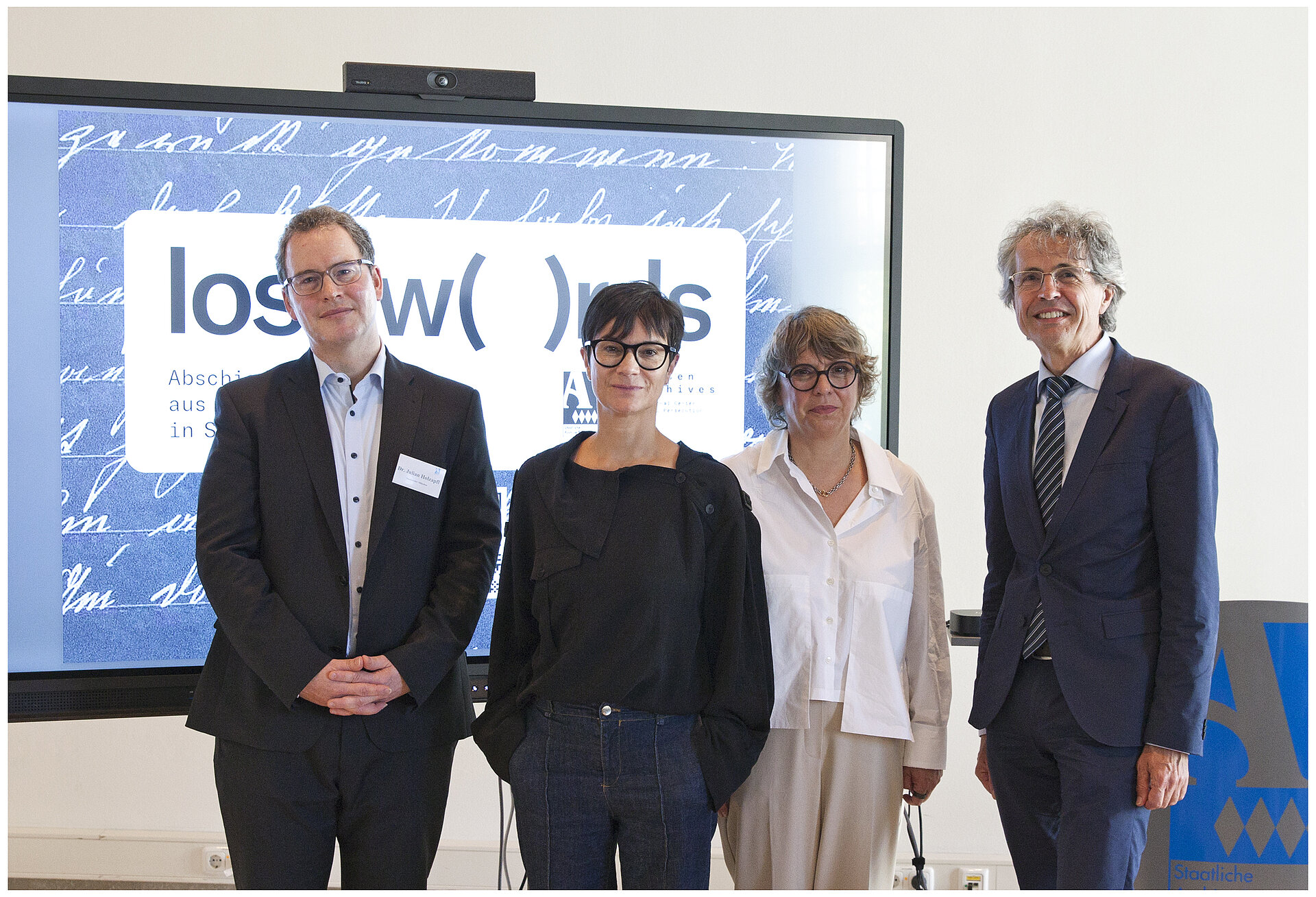
The detention centre in Munich-Stadelheim acted as a “central detention centre” in the Nazi justice system and is one of the main places of the Nazi injustice in Munich with over 1000 known executions by 1945. The 844 so-called execution files of the JVA München-Stadelheim, which have been stored in the State Archive Munich since 1975, contain more than 50 unsubscribed letters from execution candidates to particularly close persons. The then prison administration and the detention centres held these letters back. The execution files are freely accessible to all scientific and private research projects, the distortion information is available online via the Finder database of the State Archives of Bavaria. In order to take account of the particular importance which the execution files or the suicide letters of the executed still have, as sources of history for the NS injustice, but also as personal evidence for the descendants of the executed, the files were systematically checked, digitized and the original letters mentioned were identified. The Arolsen Archives are the international centre of Nazi persecution with the world's most comprehensive archive on the victims and survivors of National Socialism. They specialize in tracking the biographical traces of NS victims up to their relatives living today. In the case of execution victims from Munich-Stadelheim, these traces lead not only to German, but above all to Polish and French families. The aim of the cooperation agreed in April 2025 is the networking of the files of the State Archive Munich with the transfer of Arolsen Archives to 17.5 million victims of National Socialism. The Arolsen Archives will try to identify addressees of the suicide note and other survivors of the executed, to contact them and to hand them copies of the original letters on request. The project is accompanied by a conciliation campaign and public events. This connects the letters beyond the existing free archival accesses. First results were presented at the press conference on 23 July and the project progress was explained. More information about the Arolsen Archives can be found here. BU 1 v.l.n.r.: Dr. Julian Holzapfl, Head of the State Archive Munich; Floriane Azoulay, Director of Arolsen Archives, International Center on Nazi Persecution; Dr. Anke Münster, Arolsen Archives, International Center on Nazi Persecution, Head of Public Relations/ Project Management; Dr. Bernhard Grau, Director General of the Bavarian State Archives BU 2 v.l.n.r.: Dr. Bernhard Grau, Director-General of the Bavarian State Archives; Floriane Azoulay, Director of Arolsen Archives, International Center on Nazi Persecution; Dr. Anke Münster, Arolsen Archives, International Center on Nazi Persecution, Head of Public Relations/ Project Management; Dr. Julian Holzapfl, Head of the State Archive Munich BU 3: Dr. Julian Holzapfl, Head of the State Archive Munich presents original files Posted on 23.07.2025.

10.03.2020: ‘Handwritten!? Messages in the pre-electronic age” - Tag der Archive im Staatsarchiv Landshut am 9. und 10. March 2020
Guided tour of the State Archive Landshut with archival presentation On the first weekend of March the 10th will be German. Tag Archives organized. This year he is entitled “Communication: From the Depesche to the Tweet”. Several hundred archives in Germany open their doors and provide insights into their work with historical documents. The State Archive Landshut participates in the following working days. On Monday, 9th and Tuesday, 10th will be held in two “Feierabend tours”. March at 16.00 a.m. in the Landshut State Archive presented the diverse tasks of the Landshut State Archive. Following this, there is the possibility to visit the distinctive new building of the state archive at the Schlachthofstraße, which was only purchased in 2016. To this end, visitors can also use the small exhibition “Handwritten!? Messages in the pre-electronic age” admire some selected originals on the subject of “communication”. One focus is on the correspondence of and with Edmund Jörg, who was born in 19th. Century as an archival on the castle Trausnitz and its 200th. Birthday was celebrated a few months ago. In addition, private letters from persons from all social classes, from young nobles to prison occupants in Straubing, who are handed over to the state archives. Location: State Archive Landshut, Schlachthofstraße 10, 84034 Landshut Time: Monday, 9. March 2020, 4 pm Tuesday, 10. March 2020. 16.00 am Meeting point: Main entrance of the State Archive Landshut, Entrance Hall Special exhibition: “Handwritten? Messages in the pre-electronic age” of 2.-13. March 2020 opens at the opening hours of the State Archive for visitors (Mo, Di, Do 8.00-16.00, Mi 8.00-18.00, Fr 8.00-13.30 h). Free admission. Guided tours for groups can be agreed by phone or e-mail. Contact person: Dr Martin Rüth, Telephone: 0871/ 92328-0 or 0871/92328-21, E-mail: poststelle@stala.bayern.de Submitted at: 06.02.2020