

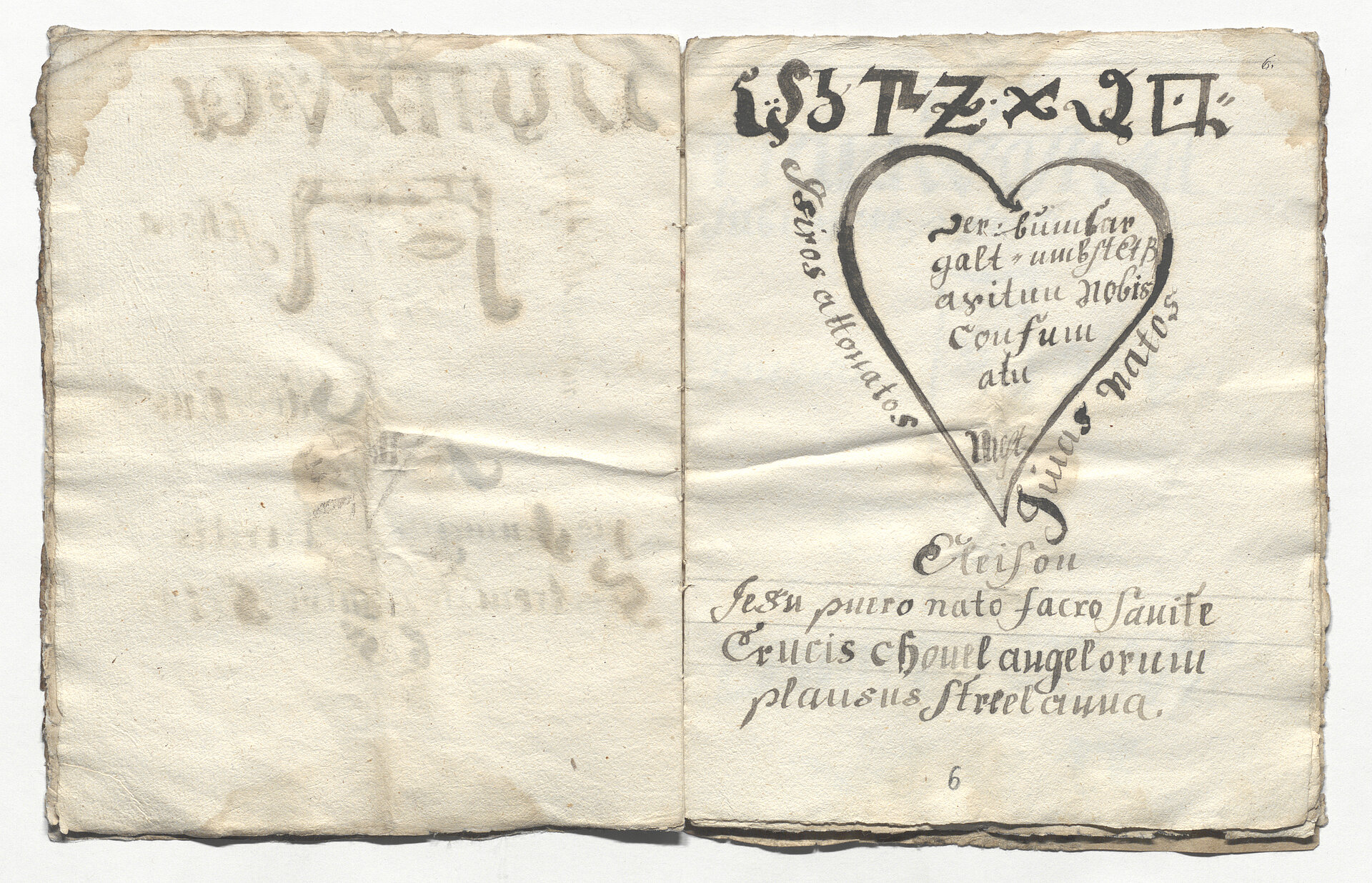
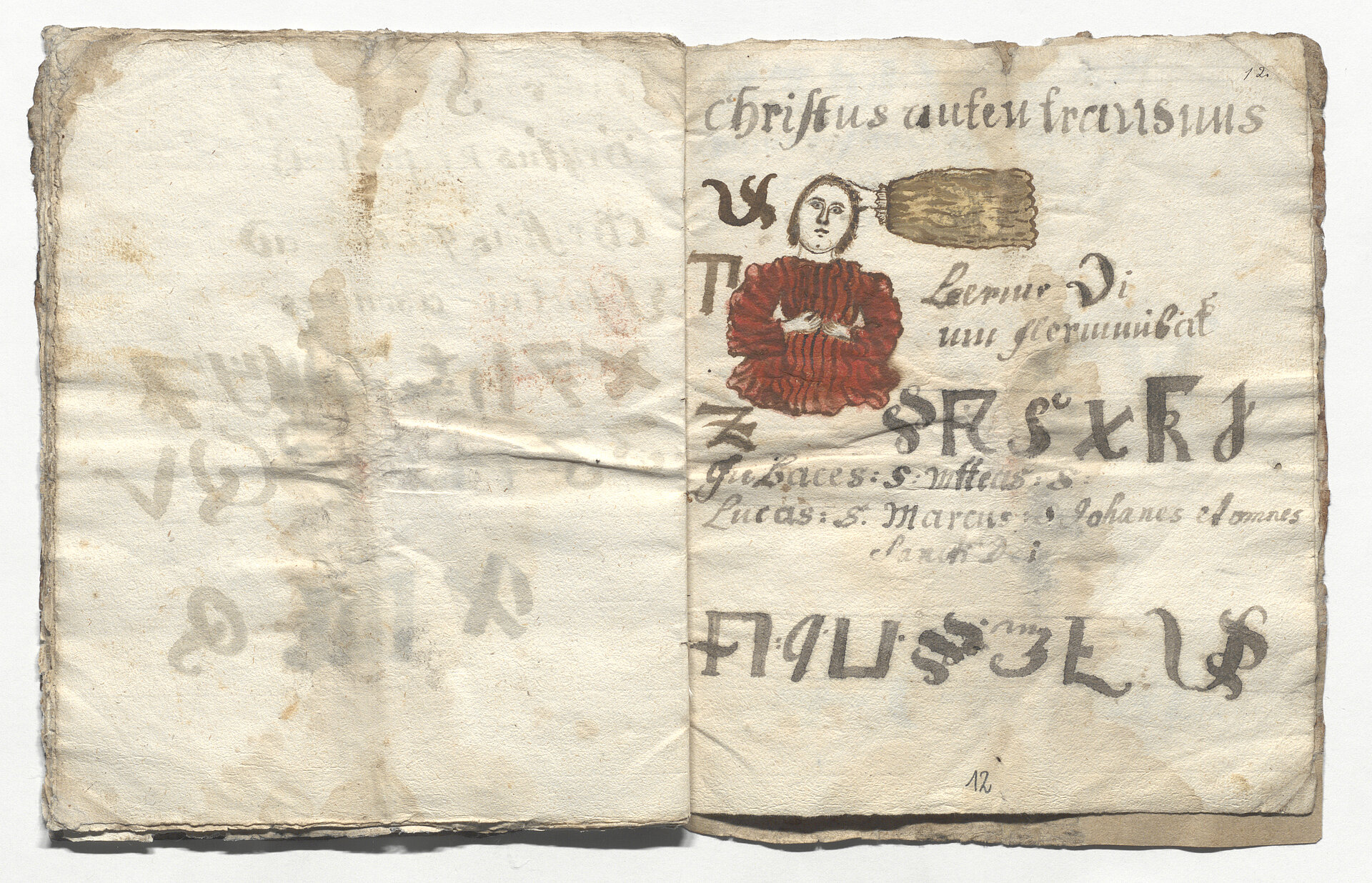
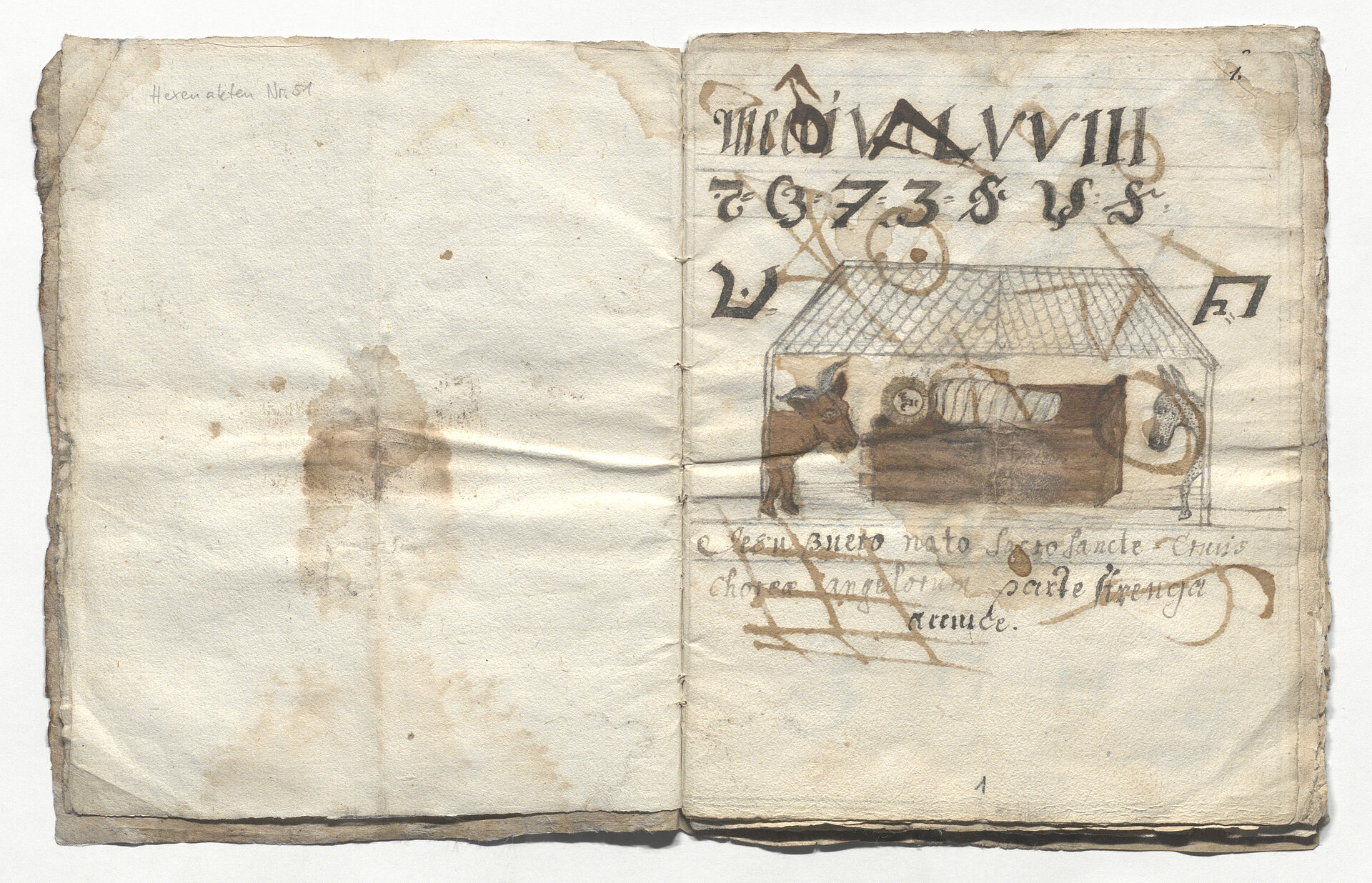
Ancient magical and occult writings fascinate not only archivists, but also many interested observers outside the immediate community. The fact that such writings are also found in archives with purely state records is rare and naturally stimulates researchers' curiosity to clarify their origin and possible content. This is also the case with the archive document from the Bavarian Main State Archive, referred to in the relevant repertory as a “book of spells,” which is preserved in the “witchcraft files” collection as a completely isolated archive document with no further file context.
Formally, the manuscript consists of 13 sheets, which were originally folded twice and were therefore considerably smaller in size than they are today. It contains various symbols and drawings reminiscent of fragments of Latin liturgy, as well as clear references to the Ten Commandments and the symbol of the Holy Spirit. It can be assumed that the author of the book did not understand Latin and reproduced what he had heard from memory, which is why it is no longer possible to make clear attributions today. A drawing of a left hand with an inscription that could possibly be interpreted as an incantation, in connection with the child hands, could indicate a paralysis spell. Child hands are the severed hands of children which, according to popular belief, were supposed to open doors for thieves on their nightly raids.
This connection could be significant when trying to determine the origin of the book: On July 20, 1704, in the district court of Tölz, or rather in the court district of Hohenburg (Lenggries), the granary of Hans Grasmüller, a farmer in Lenggries, was broken into and six sacks of flour were stolen. So, on July 21, they didn't hesitate to visit Martin Eheham, or so-called Jacob Martha and Balthasarn Wönig [both from Lenggries], who were suspected of the crime, and it turned out that a fresh calfskin and three sacks full of flour were found at Ehehamb's place, whereupon he – Ehehamb – was immediately arrested and taken to the magistrate's office in Lenggries, but he unexpectedly broke free from his bonds and fled.
However, Balthasar Wenig was arrested on July 23, 1704, and handed over to the Tölz court at the usual transfer point. He was imprisoned in the Fronfeste and reports began to be obtained from the Hohenburg court. At the same time, Wenig was interrogated and a report including transcripts was sent to the court council in Munich on August 4, 1704. On August 9, instructions were issued from there to show Wenig the instruments of torture in order to persuade him to make further statements. However, the search of Martin Eheham(b) [Ehaim] in Lenggries appears to have been particularly revealing, as a book of a magical nature was found in his possession, which is why the Tölz district court wrote to the Hohenburg court judge that he should hand over the superstitious book found at Marthin Eheham's and have some experienced persons brought in to hear from their experience how and in what way and at what time the same had freed itself from these bonds.
There was therefore speculation that Ehaim had only been able to free himself from prison through magic, using the magical practices recorded in the book. The evidence was graciously requested by means of a most humble report from Ehehamb and sent by the superstitious Pichl to the Most Honorable Court Council by his own potter. The book arrived at the court council in mid-August, together with a report, and on August 20, 1704, the court council ordered that the aforementioned Wönig be brought here, safely guarded, to the Falkhenturm prison, but that the fugitive Ehehamb be treated with kindness and goodwill, so that he might be brought back and delivered here.
On September 4, 1704, Wenig was admitted to the Falkenturm in Munich, from where he was released on October 20 and sent back to Tölz with the order to publicly confront the aforementioned Wönig, read him his rights for theft and poisoning, and have him hanged.
It can therefore be assumed that the “magic book” presented here may actually have been in the possession of Martin Ehaim from Lenggries and that the hand in the book served as a means of escaping from prison. This would also explain why the book has been handed down without any file context, as this never existed, and it would also explain the creases in the book, as it was carried around. No definitive proof can be found, as the book contains no evidence of its origin, but the historically documented story presented here can certainly be linked to the magic book in question.
Christoph Bachmann
All images: Bavarian Main State Archive, Witchcraft Files 51.
Posted on September 4, 2025.