

09.03-09.04.2020: Exhibition "Die Geschichte der Post in der Oberpfalz im 19. und 20. Century"
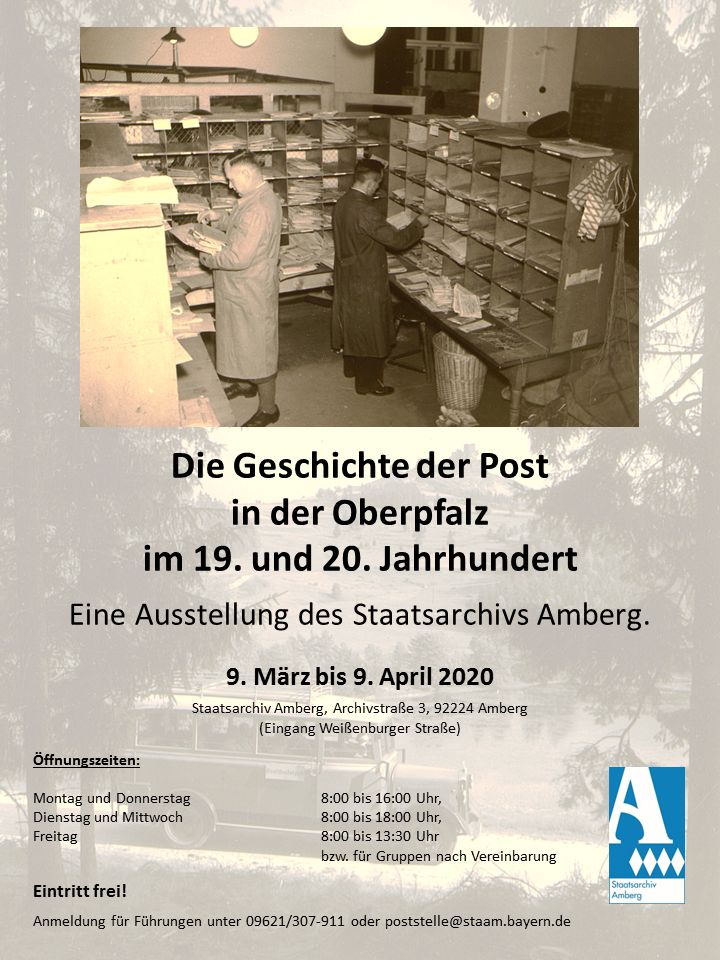
Special exhibition at the Amberg State Archive for 10th. Tag Archives on 7. March 2020 Since 19. In the 1990s, post and rail reforms were conducted by the government. In addition to the transport infrastructure, powerful news systems created the foundations for the industrialization and modernization of Bavaria and Germany. The history and performance of the post office in the administrative district of Oberpfalz in the 19th and 20th are exemplarily provided by original archives and private loan offerings. century shown. In addition to the promotion of letters and the telephone and telegraph service, this included the transport of persons and goods by road and payment. In addition, the focus is on the operations, the different buildings and the staff of the postal service. There are also two spectacular cases where the post in the region was targeted by criminals. From 16. March RESOLUTION on CORONA - The exhibition is from the 9th March 2020 to 9 April 2020 (State Archive Amberg, Archivstraße 3, 92224 Amberg; Entrance Weißenburger Straße). Opening hours: Monday and Thursday 8:00 to 16:00, Tuesday and Wednesday 8:00 to 18:00, Friday 8:00 to 13:30 (Sa and So closed; Special opening on 7. March 2020 from 10:00 to 14:00. Free admission. Guided tours for groups can be agreed at 09621/307-911 or poststelle@staam.bayern.de. Submitted on: 18.02.2020
Read more→

09.03.2020: Selected documents on "Communication" - Tag Archives at the Coburg State Archive on Monday, 9th March 2020
The 10th day of the archives will be held on the first weekend of March. Several hundred archives in Germany open the doors to their treasury chambers and show their work with historical documents. Opening hours on Monday, 9 March 2020: The State Archive Coburg presents selected documents from its collections on the topic ‘Communication’ means: Famous letter writers like Martin Luther more of the written form of communication Beginning of 20. In contrast, some Coburg pioneers experimented with the Communication via radio and radio waves And how did the Communication at the German-German border in the period of the Cold War? Subsequently, a public tour takes place through the magazine of the State Archive. Contact person Dr. Alexander Wolz, Birgit Hufnagel, Email: poststelle@staco.bayern.de Submitted at: 06.02.2020
Read more→

07.03.2020: History of the Post in the Oberpfalz - Tag der Archive im Staatsarchiv Amberg am 7. March 2020
On the first weekend of March the 10th will be German. Tag Archives organized. This year he is entitled “Communication: From the Depesche to the Tweet”. Several hundred archives in Germany open the doors to their treasury chambers and show their work with historical documents. Lectures on the history of the post in the Oberpfalz (10-13) Welcome (Dr. Maria Rita Sagstetter, State Archive Amberg) The post in the Oberpfalz. Formation - Structures – Formation (Dr. Martin Dallmeier, Regensburg) Stocks on post history in the Amberg State Archive (Dr. Till Strobel, Amberg State Archive) Introduction to Exhibition “History of Post in the Upper Palatinate in 19th and 20th Century’ (Jochen Rösel M.A., Staatsarchiv Amberg) Guided tour of the Amberg State Archive (13 – 2 pm) Participation in the leadership is also possible regardless of the attendance of the lectures. Exhibition It is also possible to: Exhibition “History of Post in the Upper Palatinate in 19th and 20th Century‘ are visited. This is also the 09.03. to 09.04.2020 open during the opening hours of the State Archive. Submitted at: 06.02.2020
Read more→

07.03.2020: Lug and Trug - Tag Archives on 7. March 2020 at the State Archive Munich
The 10th day of the archives will be held on the first weekend of March. Several hundred archives in Germany open the doors to their treasury chambers and show their work with historical documents. Program of the State Archive Munich: Read more Winfried Frey reads from files on Curious Fraud Cases from Upper Bavaria: A Munich bank scandal (Adele Spitzeder) Love under conditions (Heiratsschwindler Graf von Falkenburg) The Savior of the Other Star (The Venus Fall) The failed healthmaker (Creb doctor Dr. Issels) Time: from 14.45, Location: Reading room, 1st floor (Pre-registration is not required) Accompanying program "The State Archive in its various facets" Guided tours for every full hour (Treffpunkt Foyer, EC) with changing priorities: View behind the scenes (General Magazine Guide), Sex and Crime, Explore the Injustice on the Track (NS-Zeit), Home and Ahnen (home and family research) (max. 20 participants, if necessary additional guided tours are offered, pre-registration is not required) Book bazaar Kneckline from Carl Orffs ASTULI with the Ensemble des Münchner Marionettentheater, Time: 2 pm Contact person Dr. Ulrike Claudia Hofmann, Tel. 089/28638-2539; Email: poststelle@stam.bayern.de Submitted at: 06.02.2020
Read more→