

Closing
The Bavarian Main State Archives will be closed to users on Wednesday, December 10, 2025, from 2:30 p.m. due to a Christmas party.
Closing
The Bavarian Main State Archives will not open until 1 p.m. on Wednesday, March 4, 2026, due to internal training.
Schließung
The reading room of the Bavarian Main State Archives will be closed on Friday, March 6, 2026, and will reopen on Monday, March 9, 2026, at 12 noon.
Use and advice after prior registration
The number of jobs in the consultancy room and in the reading room of departments I, II and V is limited. We therefore ask for a pre-registration at 089/28638-2555 or by email Reservation@bayhsta.bayern.de
Office hours:
Mo - Fr 8:30 -12.00
In the reading rooms of the Bavarian Main State Archive Users also create digital photographs from archives. Further information on the conditions can be found in the Use notes.
Address:
Schönfeldstr. 5-11
80539 Munich
(box 22 11 52,
80501 Munich
Tel. 089/28638-2596
Fax 089/28638-2954
E-mail: poststelle@bayhsta.bayern.de
Abt. III Secret Home Archive *
Entrance: Ludwigstr. 14
80539 Munich
Tel. 089/28638-2517, Fax 089/28638-2901
E-mail: hausarchiv@bayhsta.bayern.de
Opening hours: Mo-Do 9.00-12.00, 13.30-16.00; Fr 9.00-12.30
Use and advice after prior registration
The number of jobs in the reading room of Division III is limited. We therefore ask for a pre-registration. Please let us know if you need the place in the morning (9.00-12.00), in the afternoon (13.30-16.00) or all day. On Friday the reading room is open only in the morning.
Abbot. IV War Archive
Leonrodstr. 57.
(bus and tram stop Fasaneriestraße)
80636 Munich
Tel. 089/18951680
Fax 089/28638-2954
E-mail: poststelle@bayhsta.bayern.de
Opening hours: Mo-Do 8.30-16.00; Fr. 8.30-13.00
Use and advice after prior registration
The number of jobs in the reading room of Division IV, War Archive is limited. We therefore ask for a pre-registration. Please let us know if you need the place in the morning (8.30-12.00), in the afternoon (13.00-16.00) or all day. On Friday the reading room is open only in the morning.
Abt.V: Estates and Collections
Entrance: Ludwigstr. 14
Postal address s.o. Bayerisches Hauptstaatsarchiv
Tel. 089/28638-2596
Fax 089/28638-2954
E-mail: poststelle@bayhsta.bayern.de
Opening hours: Mo-Do 8.30-16.00; Fr. 8.30-13.00
Head:Director of the State Archives Dr. Christoph Bachmann M.A.
Sprengel: Authorities and bodies responsible for the entire territory of the State.
Stocks:
- as the central archive for the Duchy, Electorality, Kingdom and the Free State of Bavaria, responsible for the former Kurbayerian and pfalz-Neuburgic central archives and central authorities, for the archives of the central archives in the context of secularization and mediatization at the beginning of the 19th century. century Bavarian fallen spiritual and secular territories without the Oberpfalz (Abbot. I Elderly stocks)
- for the Bavarian state ministries and other state authorities responsible for all Bavaria since approx. 1800 (Abbot. II New stocks)
- mixed stocks formed according to material pertinence predominantly Kurpfalzbayerischer und royal-bayerischer centralbehörzen on the history of the Haus Wittelsbach as well as the documents handed over by members of the kgl house (Abt. III Secret Home Archive*)
- the document of the former Bavarian army of 17th Century to 1919 (Abbot. IV War Archive)
- State authorities' articles of 19 and 20. non-governmental archives, e.g. political estates, writings of corporations, parties associations and collections such as posters, leaflets, prints etc. (Abt. V Discounts and Collections)
*The use of the abbot. III Secret home archive is subject to the approval of the head of the house Wittelsbach.
Several stocks are stored in a depot that is only raised once a week. A telephone request is therefore recommended before planning an archive visit.
Volume: 56.301 lfm. with approximately 4,11 million archive units (as at 31. December 2024).
Transport: Odeonsplatz Metro Station
Virtual reading room
Click here to access the virtual reading room of the Bavarian State Archives.
According to the Regulation on the breakdown of the Bavarian State Archives of 28 May 1990 (GVBl p. 175), the Bavarian Main State Archive “is responsible for archiving the archived goods of the state bodies responsible for the entire territory of the state”. In detail, as a central archive for the Duchy, Electorality, Kingdom and the Free State of Bavaria, it is responsible for the former Central Archives of Kur-Bavarian and Pfalz-Neuburgic and Central Authorities, the Kurpfälzische und Pfalz-weibrückische Tradition, the archives of the Kurpfälzische und Pfalz-z-zweibrückische Tradition, which remained in the context of secularization and mediatization. Jewish spiritual and secular institutions of the Bavarian Reich Circle (without Oberpfalz) (Division I Older Stocks), for the Bavarian State Ministries and other state authorities responsible for all Bavaria since approx. 1800 (Division II New stocks), for mixed stocks formed according to material, predominantly Kurpfalzbayerischer und royal-bayerischer Zentralbehörliche Provenienzen zur Geschichte des Hauses Wittelsbach as well as the written goods (Division III Geheimes Hausarchiv), the archives of the former Bavarian army of 17th Jh until 1919 (Department IV War Archive) and the document of non-self-acting bodies under the supervision of the State, institutions and foundations of public law, as well as non-governmental archives for supplementing the administrative files, all political decrees, association articles and articles of association such as posters, leaflets, prints etc. (Department V).
According to the cited breakdown regulation, the Bavarian Main State Archive continues to be “the central technical tasks assigned to it”. These currently consist of the practical implementation of the reprography including protective filming and restoration and preservation.
The Bayerische Hauptstaatsarchiv was published by a regulation dated 16. July 1921 (GVBl S. 379) founded by the organizational association of the three central archives, the General Reichsarchive, the Secret State Archive, the Secret House Archive, and the then District Archive Munich (now State Archive Munich). The three central archives mentioned were by the archive statue Kurfürst Max IV. Josephs of 26 June 1799 was formed from the Wittelsbach central archives, the interior or secret archives, the exterior (acts) archive and the secret state registry set up for the Foreign Department of the Secret Council according to material pertinence. The secret archive (since 1812 General Reichsarchiv) should record archives relating to the internal state administration and the relations with the individual German state states, the secret state archive received the mass of the secret state register and was intended for the archives which had the ratio of Kurpfalzbayern to the foreign country and to the Reich to the content, and the secret home wittel should be responsible for the secret home affairs. In accordance with their responsibilities, the secret state archives and the secret home archives also obtained extensive collections from the Kurpfalz and Pfalz-Zweibrücken hospitals. These archives formed from the foundation of the Bavarian Main State Archive in 1921 until its reorganization on 1st. January 1978, its departments I General State Archive (so-called since 1960), II Secret State Archive and III Secret Home Archive.
The archives organization of 1799 led to a division of existing funds which, as a result of the inadequacy of the principle underlying it, was very arbitrary and susceptible. As a provincial archive of the “Province of Baiern” (Altbayern without Oberpfalz), the secret Landesarchiv was also responsible for the archives of the monasteries and high donations dissolved by secularization in the area of today’s Upper and Lower Bavaria. After the creation of the Kingdom of Bavaria (1806), it was declared the General Archive of the Reich in 1812, that is to say a universal central archive which encompasses the entire kingdom and which, in addition to all other archives in the Kingdom, should only represent branches. A centralization of such large quantities of archivists, now also from other areas of growth (e.g. Schwaben, Tirol and Salzburg), was only to be carried out with the strictest selection. In this case, there were differences between "archival" documents, among which the originals and a selection of important official books and files (so-called literals) were counted, and "non-archival" documents, to which the mass of the other documents (acts, recent official books, protocols, invoices, etc.) was counted. The General Reich Archive should only take over the “archival” font. This was ordered according to the perspective of the individual documents. In this way, the archives of the institutions and territories of the old Bavarian-Swiss region, which have fallen since secularization and mediatization, were completely mixed together, and the original funds were largely destroyed. In general, Reichsarchiv as in his file depot (the later circular archive and today's state archive Munich) huge mixed stocks were created (see, inter alia, p. 13 and 25). These principles were, however, only in the concentration of documents before 1401 in Munich. The "non-archival" document was handed over to the archive conservatories, the precursors of today's state archives (until 1921 Kreisarchive) in the individual government districts. In Munich, the archive conservasodium was directly linked to this as the actual file division of the All Community Reich Archive until 1825 and became a separate department of the Bavarian Main State Archive in 1921. In this capacity, it was named ‘Staatsarchiv für Oberbayern’ from 1960 onwards. In 1971, under the name of the State Archive Munich, it was removed from the Association of the Bavarian Main State Archives and, as a self-employed authority, the other state archives in Bavaria (cf.
The archives organization of 1799 and the destruction of the growing funds that occurred in its succession were in contrast to that of the 19th century. The principle of provenance, which is generally recognized today as an archival principle, i.e. the historical order of the archivia according to its origin. Despite the organizational merger of the Munich Central Archives of 1921, however, these demands were only given a hesitant space in practice. The individual departments of the Main State Archive remained in their home, separate premises, and a stock cleaning between them was not undertaken. But one made a first step towards the restoration of historical relationships by starting to apply the principle of provenance to the originals of the Old Bavarian-Swibian archive area, which were almost completely stored in the former department I of the Main State Archives. These document funds have been reconstructed, mainly due to the systematic analyses of the 1960s and 1970s. The historical files and official books (in Bavaria since the 19th century mostly referred to as Lite-ralien) were divided not only between the Munich central archives, but also between them and the state archives (previously archive conservatories, then circular archives) in Altbayern and Schwaben. In this respect, the restoration of historical funds first presupposes the establishment of clear powers for the historical authorities. This was due to a comprehensive settlement in the Old Bavarian-Swibian region and was an important prerequisite for the reintegration of the Bavarian Main State Archive of 1 January 1978. The historical competence in the Old Bavarian area was determined in such a way that the Bavarian Main State Archives were responsible for all the archivals of the Kurbayerian and pfalz-neubur-gien central authorities as well as the high-level foundations, monasteries and few worldly state stands of the former Bavarian Reich Circle (without Oberpfalz), while the state archives of Munich and Landshut became the Kurbayerische Mittelgewiesen. The Amberg State Archive is responsible for the holdings of the historical Oberpfalz (Prince of the Upper Palatinate). This initial definition of unambiguous responsibilities in the Old Bavarian archival area led to an exchange of large-scale stocks between these archives. The archives of the former Schwäbischen and Austrian Reichkreis were assigned to the Swabian State Archive, which has been located in Augsburg since 1989 (cf. The recently centralized documents of Franconian Provenienzen until 1400 were returned to the state archives in Bamberg, Nuremberg and Würzburg in 1993/94.
The move to the new building on Schönfeldstraße was the occasion of the planned reorganization of the Bavarian Main State Archive on 1st. January 1978. Its core was the association of the collections divided into the former departments I General State Archive (former General Reichsarchiv) and II Secret State Archives and their division into one department each for the older and newer holdings with the time cut around 1800.
The Bayerische Hauptstaatsarchiv has been composed of the six departments since this time: Z (Central Affairs), I (Elderly Stocks), II (Neuere Bestands), III (Geheimes Hausarchiv), IV (Kriegsarchiv, built in 1885 and classified as department in 1946) and V (Residences and Collections).
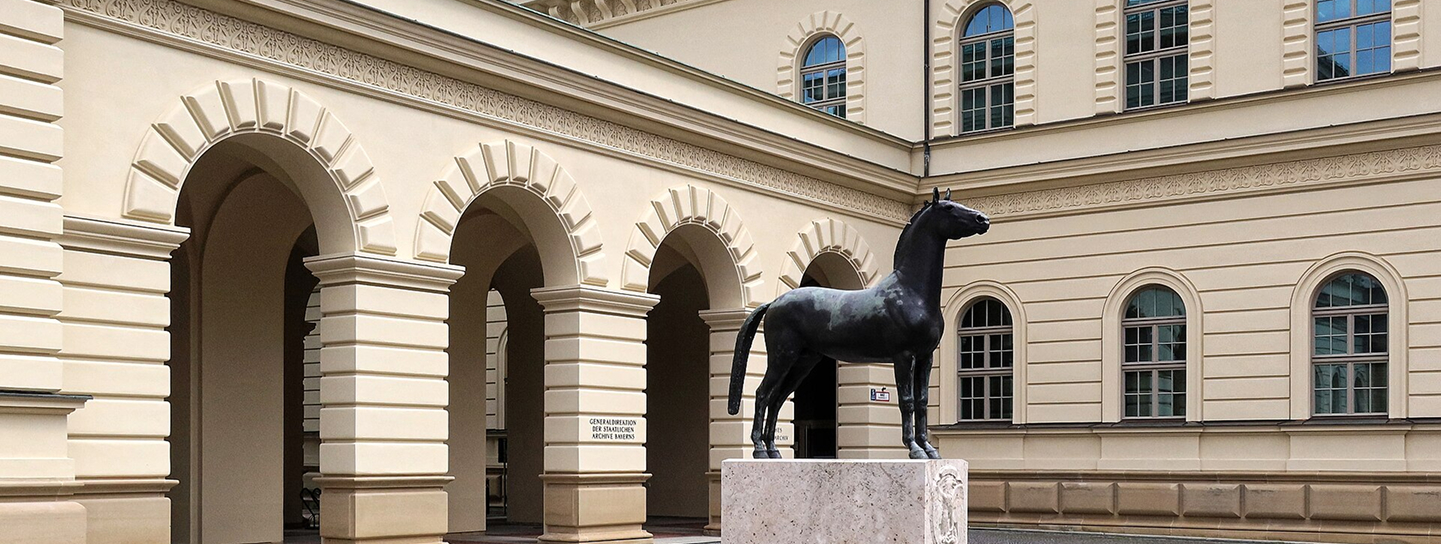
The Bayerische Hauptstaatsarchiv was located until 1944 with the Bayerische Staatsbibliothek in the monumental archive and library building Ludwigstraße 16 completed in 1843. After this destruction in the Second World War, it was not necessary until 1977 in the Arcisstraße 12 building, one of the so-called guide structures, since the building on Ludwigstraße, after its rebuilding, could only record the state library. In 1977/78 it referred to the classicist building complex at the Ludwig/Schönfeldstraße, in which some Jahre had previously already taken up the Secret House Archive and the former Secret State Archive as well as the State Archive Munich. In 1822 to 1830, these buildings were commissioned by King Ludwigs I of Leo von Klenze for the then Bavarian Ministry of War, destroyed during the Second World War and rebuilt since 1964 for the Bavarian Main State Archive and supplemented by a modern magazine and administrative building.
The War Archive Division IV is located in the building Leonrodstraße 57, built in 1928. The mass of its holdings together with those of the other departments of the Main State Archives and the State Archives of Munich are situated in the subsequent magazine building on Fasaneriestraße (built as a military trainee depot 1897/98).
The use depends on the usage order for the state archives of Bavaria of 16th. January 1990 (GVBl p. 6) in the current version, which also regulates the use fees. No fees are charged for scientific, home-healthy, family-historical and educational purposes. Restrictions in the use can be necessary mainly because of the preservation state of the archivia or, if protected concerns are contrary to those concerned and third parties. In particular, prior to the end of 30 years since its birth, personal documents before the end of 10 years after death or 90 years after the birth of the person concerned, as well as documents of other secrecy character before the end of 60 or 80 years since their birth. Other special arrangements exist for individual special stocks and Deposita (approved). Shortenings of deadlines at special request are possible. The use of the Division III Secret Home Archive is subject to the approval of the head of the House Wittelsbach.
A reading room with 40 seats is available to the users in the main building on Schönfeldstraße. Sections III and IV have their own reading rooms.
The collections are developed by repertoire (finding books) of different executability and intensity in band or cardiform. The cardiovascular documents available in the Bavarian State Archives up to 1400, in which around 58,000 documents are carded after the date and names of the exhibitors and the Sieglers, as well as the personal, local and non-material cardiovascular records of the ministries and other national authorities of 19 and 20. century (approx. 350,000 files mapped).
The library (presence library) contains approximately 175,000 volumes, including the two sub-library libraries in departments III Geheimes Hausarchiv and IV War Archive. Collections are: archives including archive technology, source editions and presentations on the Bavarian and German history, historical aid sciences, Bavarian and German history, administrative, legal and church history, history of Hauses Wittelsbach (Abt. III Secretes Hausarchiv), Bavarian and German military history up to the First World War, including regulations.
In the main reading room on Schönfeldstraße there is a free hand library of about 9,200 banks available to the users.
Microfilm (fiche) readers and reader printers are used as technical aids. Connections for primary electronic input devices are provided. Photo orders are wound in accordance with the valid directory for the production of photo images in the archived photo workshop. Readerprinter copies can be prepared by the user himself. The Bayerische Hauptstaatsarchiv has its own restoration plant, which also works for the other state archives.
Total scope:
The holdings of the Bavarian Main State Archive (as at 1.1.2014) are around 3.9 million units of activity of approximately 50.420 metres (lfm). The oldest document dates from 794. In each case, the main state archive retains approximately 276.300 documents (3,460 lfm), more than 624.000 files and volumes (13.160 lfm) and, after meters, unveiled selects and collections of nearly 25,000 cards and plans, and 226.000 seal reproductions and coat images, from the time after 1800 approximately 5.330
Here you will find an overview of the literature.
The Bavarian State Archive in Munich is the central archive of the Free State of Bavaria. It preserves the most important sources of Bavarian history from 8. Century to today. With its 3.8 million individual documents, it is one of the largest and most important archives in the world. The archive also needs support from the company for its fulfillment of tasks in the field of cultural care.
Founded in 2001, the association of the "Friends and Sponsors of the Bavarian Main State Archives" has set itself the goal:
- to make the Bavarian State Archive known to a wider public
- support the Bavarian State Archive for the acquisition and preservation of archived goods
- to provide funds for restoration and preservation of endangered archives to the Bavarian Main State Archives
- promote the historical-political educational work of the Bavarian Main State Archive (publications, exhibitions, conferences).
In order to fulfil these tasks, the Bavarian Main State Archive is dependent on the participation and financial support of as many friends and sponsors as possible. By offering scientific lectures, events and invitations to exhibition openings, the association of members of the association with the Bavarian Main State Archive is to be consolidated.
The annual membership fee is 30 euros, 40 euros for partners and 100 euros for legal persons. Member contributions and donations are taxable.
Membership
If you would like to join the Association of Friends and Sponsors of the Bayerischer Hauptstaatsarchiv e.V., please fill out the form you wish to enter Download here (PDF flyer with registration form) can and send it to us filled by mail.
Find our articles here (PDF file for download).
Dates and events
If you would like to be informed by email about the events of the association, please give us your email address foerderverein@bayhsta.bayern.de known.
Mouth nose protection with logo
With the support of the association, a mouth-nut protection was made available to all employees of the Bavarian State Archives with the logo "Staatliche Archive Bayern". A few copies are still available, which can be purchased from members for reimbursement of production costs (€ 6) to the club account. Please order by email.
Figure: Mouth nose protection with logo
Current and completed projects
Current projects:
- Restoration project: New packaging of oversized state contracts of the 19th century century from stock Bavarian certificates (start: 2014)
Completed projects (excerpt):
- Support of the project "Mund-Nasen-Schutz mit Logo" for all employees of the Bavarian State Archives (2020)
- Support for printing costs, directory of estates in the Bayerischer Hauptstaatarchiv, Bayerische Archivinventare Bd. 58 (2019)
- Purchase of an invoice book by Rothenberg Fortress from 1692 for Division IV War Archive (2014)
- Support of the exhibition "Krieg! Bayern im Sommer 1914" (Bayerisches Hauptstaatarchiv, 24.6.-1.8.2014): Purchase of a mobile Litfaß column, leaf printing, reception on the occasion of the exhibition opening (2014)
Figure: View into the first exhibition room with litfaß column
Figure: leaflet for exhibition
- Buying a map of military provenance of a subarea of the Bavarian Forest (um Rinchnach) from 1803 for the War Archive Division IV (2013)
- Restoration project: Court war record (2012-2013)
Figure: Band Court War Council minutes before the measure and thereafter
- Support in the creation of "Notare and Notarssignete from the Middle Ages to 1600 from the collections of the Bavarian State Archives. Follow-up: Functions and places of administration, evidence of sources, indices and supplements. Created and edited by Elfriede Kern and Magdalena Zwarder with the help of Karl-Ernst Lupprian and Susanne Wolf. General editor: Susanne Wolf, Munich 2012." (2012/2013).
Figure: Title sheet of Notarssignete
- Support in the creation of the four-volume archive inventory Bavarian Country Day (since 2010)
Friends and sponsors of the Bavarian Main State Archive
c/o Bayerisches Hauptstaatsarchiv
Schönfeldstraße 5
80539 Munich
Tel.: 089/ 28638 2596
Fax: 089/ 28638 2954
E-mail: foerderverein@bayhsta.bayern.de
You can find the virtual tour of the State Archives here: Start tour
Address
Schönfeldstraße 5-11, 80539 München (Postfach 22 11 52, 80501 München)
Contact
Tel. 089/28638-2596 Fax 089/28638-2954 E-Mail: poststelle@bayhsta.bayern.de
Management
Director of the Main State Archives Dr. Christoph Bachmann M.A.