
Use and advice after prior registration
The number of jobs in the reading room is limited. We therefore ask for a pre-registration. Please let us know when and how long you need the place. On Friday the reading room is open only in the morning
In the reading room of the State Archive Coburg Users also create digital photographs from archives. Further information on the conditions can be found in the Use notes.
Head: Archivamtsrat Marcel Oeben
Sprengel: Circle-free city and county Coburg
Stocks:
- former Duke House and State Archive
- older Coburger authorities
- Authorities of the former Free State of Saxony-Coburg
- Authorities and courts from approx. 1920 in the district of the city and the district of Coburg
The historical explosive reaches considerably into the southern Thuringian region, comprises the office of Königsberg (1879-1920 part of the district of Coburg) and for the period 1816-1834 the territory of the left-Rhine Principality of Lichtenberg (now districts of St. Wendel/Saar and Kusel).
Click on the box Online finders and online digitalisates on the Home of the State Archives you get access to the
Online Findings of the State Archive Coburg.
Volume: 4.474 lfm. with approximately 420.815 archive units (as at 31. December 2024).
Transport: Bus stop Theaterplatz.
Virtual reading room:
Click here to access the virtual reading room of the Bavarian State Archives.
The State Archive Coburg is the State Department responsible for all questions of archives in the city and in the district of Coburg. The archivist comprises the territory of the district-free city and of the district of Coburg, in their respective scope, with all the state authorities and courts located therein, even if their jurisdiction extends beyond the territory of the district (e.g. the district court, prosecutor's office, tax office, survey office, employment office, trade supervisory office). The historical jurisdiction extends to the former Duchy of Saxony-Coburg and its precursors (New reign of the Counts of Henneberg, Saxon Ortlande in Franken, Pflege Coburg, Fürstentum Coburg) and to the Free State of Coburg, which was created after the dissolution of the Staff Union of Saxony-Coburg and Gotha in 1919, until its integration into the Free State of Bavaria in 1920.
The State Archive currently holds (as of December 2018) approx. 405.536 Archival units, including about 14,200 documents, 10,500 maps and plans, as well as 14,000 photos and pictures, totalling around 4,50 running meters (lfm).
The use of the archive depends on the use order for the state archives of Bavaria of 16th. January 1990 in the valid version (GVBl p. 6), which also regulates the use fees.
From evidence it can be concluded that the counts of Henneberg held a document archive on the Veste for their territory around Coburg, which passed to the Wettiner in 1353. This archive was supplied with excreted documents from the landlord authorities located in Coburg, but important archives flowed particularly after 1485 into the main archive of the Ernestine Wettiner to Wittenberg as well as into the archive in Weimar. Approaches to an archive organization (a first inventory found at the end of the 15th century) It is only possible to establish under Duke Johann Casimir at the turn of the 16th to the 17th century. century ordered a personal responsibility to dispense domestic matter from the Registry Archive, enforced a limited inventory cleaning with the archive in Weimar and sought to regulate the administration of its archives by regulations. The archives scattered over three camp sites (Veste, Schloss Ehrenburg and Law Firm) again suffered after 1638 (the first coburgic branch of the Ernestiner) losses by transporting them to the residences of the government successors until a new independent Principality of Saxony-Coburg (1680-1699) could be stabilised by the princely archival Dr. Georg Paul Hönn. The political and economic circumstances (1699 began long-lasting hereditary disputes) did not allow special care for the archives in the next hundred years. In 1735 Coburg became the residence of the Principality of Saxony-Coburg-Saalfeld. Since 1826, Gotha was also the residence of the Duchess of Saxony-Coburg and Gotha. At the beginning of 19. Johann Adolph v. Schultes, a historian of Henneberger, laid the foundation for the order of the Duke's House and State Archives, which was permanently shaped by the Goth Archive Council Ludwig Hermann (1852-1867). Based on the 1826 Hildburg-based inheritance agreement, the Coburg archives had to hand over to the Thuringian State Archives Meiningen in 1875, which covered the southern Thuringian space. The home and state archive was handed over to administration in 1919 under the name "Coburger Landesarchiv" of the Coburger Landesstiftung.
After the association of the Free State of Coburg with the Free State of Bavaria (July 1, 1920), in 1924 a state archive department was established in the Schloss Ehrenburg next to the Landesarchiv Bamberg. It took this from the state authorities, partly up to the 15th. century rich writings that had not come into the Ducal House and State Archives. Files from the state church sovereignty and supervision came to the Landeskirchliche Archiv in Nuremberg. After the administration of the Coburg National Archives by the State Archives Division (1937) and the first collection of all archives (1938) in the eastern castle wing, the independent state archive Coburg was built in 1939. In 1973, he was classified as a self-contained stock. Income space shortages ended in 1990 with the transfer of the state archive into the witness house, which was rebuilt for its purposes.
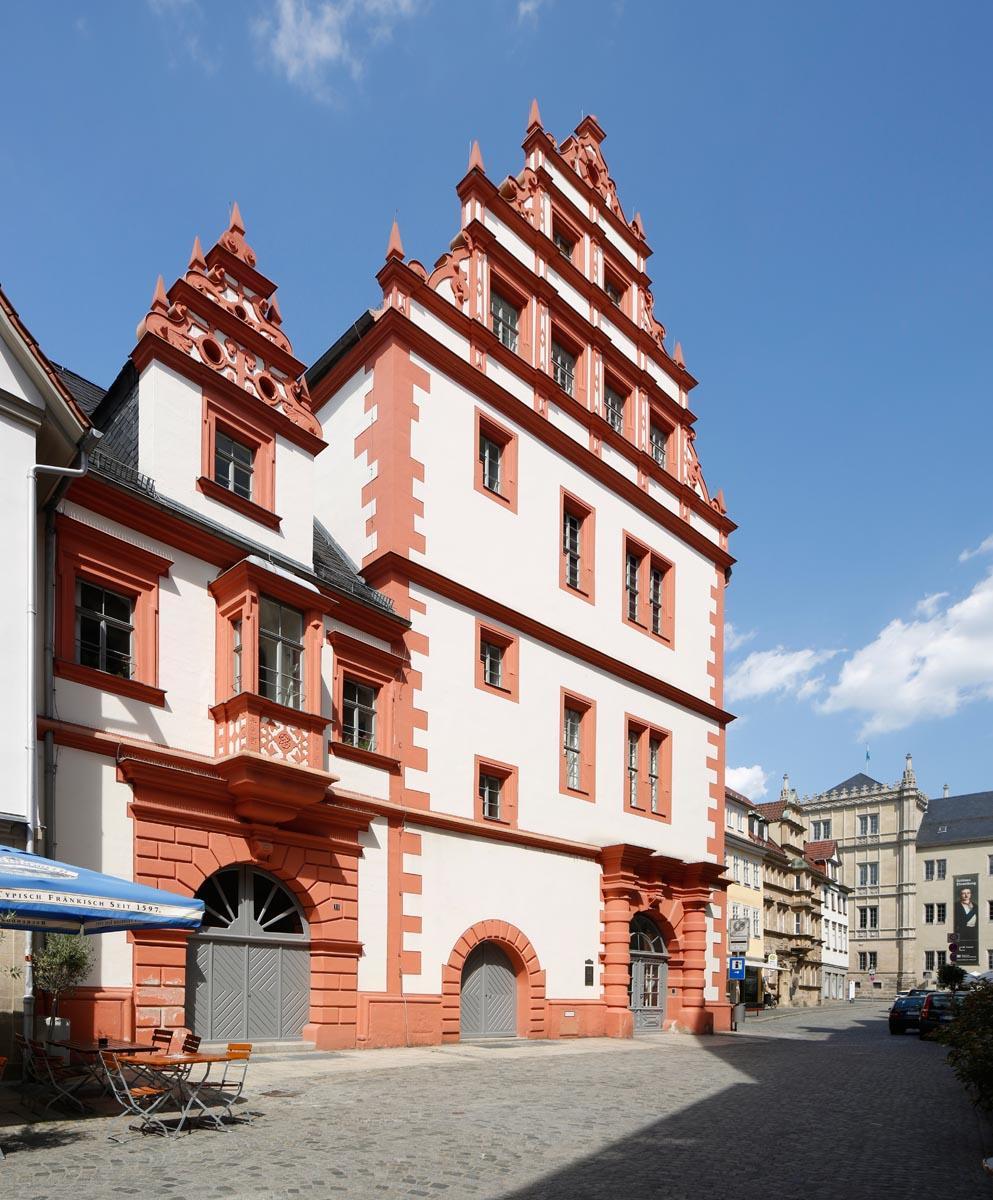
Between 1616 and 1621 under Duke Johann Casimir von Sachsen-Coburg, the witness house, which was purchased by the State Archive in 1990, was built by the painter and master builder Peter Sengelaub (around 1558-1622) in Renaissance style as a princely set-up chamber at the Herrgasse. Between Schloss Ehrenburg, where the state archive was housed until 1990, and the marketplace, the three-storey building sets a striking inner-city accent. His original function was lost during the Thirty Years War to serve the various purposes of administration, justice, culture (theater) and economy. The cellar vault and half of the ground floor have been leased to a traditional Coburg wine shop. The building had to be rebuilt inside for the purposes of a modern archive, in particular to satisfy the static requirements, from scratch. The new, modern built-in fixtures are effective from the historic outer facade. The interests of conservation of monuments were fully taken into account during the reconstruction.
The collections reflect a part of the history of the Scandinavian-ernestin countries whose divisions have strongly influenced the image of tradition. For the period of the Ernestine Kurfürsten (1485-1547) and its immediate successor with the residence in Coburg (especially Duke Johann Casimir 1586-1633), the archives also extend to the south-thüring region. However, after the energization of the coburgic branch of the Ernestiner, they are smeared by levies by the dukes of Saxony-Gotha-Altenburg after 1638. In the 19th century, administrative records of the reign of Lichtenberg (1816-1834, then sold to Prussia, today county of St. Wendel, Saarland) as well as documents of the office of Königsberg [i. Bay.] in Unterfranken (now part of the county of Hassberge, since 1920, had come to the deton of the state archive Würzburg) which had arrived at the last division of Saxony-Hildburg in 1826 On the other hand, the existence of a state ministry common with Saxony-Gotha within the Duchesses of Saxony-Coburg and Gotha (1826-1918) connected with the personnel union led Coburg to the Thuringian State Archive Gotha (for example, the personnel files of the state officials since 1858) because the relevant files were led to the ministerial department there.
Over the next few years, a comprehensive intra-archive disease control in stocks is required. Senior judicial authorities, District Court and Country Council planned.
In addition to the conventional find books (repertories) in band form, extensive maps (persons, locals and to a lesser extent index of material) are available for a large part of the stock and special maps (emigrations 19. century, plans and maps, personal pictures) available. A number of foreign repertoires and special inventory points to archives in neighbouring archives relevant to the history of coburg. More detailed information on the content of the stocks listed below can be found in the inventory overview of Klaus Frhrn. v. Andrian-Werburg (see literature list).
- Please note: in the finder database of the Bavarian State Archives can currently be used to 67 stocks of the state archive Coburg online research. The online finders can be seen within the overall classification of the holdings of the State Archive Coburg (Tektonik) on their blue marking. The offer is continuously expanded.
- For questions on all other stocks listed in Tektonik, You will first find information below the "D.bestand" point (July 2019) on the left hand side of the tree, or get directly to the State Archive Coburg turn.
The library serves to develop content and supplement archives. The books of the Ducal House and State Archives and the State Archives as well as the State Archives Department (see section A above). It focuses on the most important historical, local and historical literature (descript and regestive works, laws and regulations, representations as well as historical journals) on the archival splash, taking into account (in decreasing intensity) the Thuringian and Franconian neighboring regions. In addition, there are basic works on archival science as well as on the historical aid sciences (genealogy, heraldics and spheres, numismatics, etc.). Due to the international relations of the Swedish House of Saxony-Coburg and Gotha, an accent is also on corresponding biographies and relevant genealogical works. The library currently comprises approx. 12.100 volumes and special prints, with about 30 percent on 19. century. More frequently required reference works and magazines are located in the hand library of the reading room (about 500 volumes).
Publications about the Coburg State Archives can be found here.
You can find the virtual tour of the State Archives here: Start tour
Address
Herrngasse 11 96450 Coburg
Contact
Tel. 09561/427 07 0 Fax 09561/427 07 20 E-Mail: poststelle@staco.bayern.de
Management
Archivamtsrat Marcel Oeben