
Mehr

06.10.2021: Presentation of Dr. Klaus Rupprecht as new head of the Bamberg State Archive
On 5 October 2021, archive director Dr. Klaus Rupprecht became publicly a new head of the State Archives Bamberg presented. He took over this task as early as July 1, 2021 and followed archive director Dr. Christian Kruse, who moved to the State Archive Nuremberg as head of May 1, 2021. Dr. Christian Kruse led the Bamberg State Archive from 1 December 2018 to 30 April 2021. After studying history and German for the Magisterium at the Universities of Erlangen and Vienna, he received his doctorate in Erlangen with a work on “Franz Friedrich Anton von Sachsen-Coburg-Saalfeld 1750–1806”. He completed his training as a scientific archivist at the Bavarian Archive School in 1988 until 1991, after which he worked in the Bavarian Main State Archives, in the State Archives of Augsburg, Nuremberg and Munich and from 2008 to 2018 in the Directorate-General of the Bavarian State Archives. Dr. Klaus Rupprecht, a native of Upper Franconia, studied history, anglistics and social studies at the University of Bamberg for the Teaching Office of Gymnasium. He received his doctorate with a dissertation on the topic of “Ritterisches Fürstentruung in Franken. The history of Guttenberg in the late Middle Ages and at the beginning of the early modern period”. After his lecture on the scientific archivist at the Bavarian Archive School in 1993 to 1996, Klaus Rupprecht worked in the Bavarian Main State Archive in Munich, came to the Bamberg State Archives in 1997, where he was Deputy Head and Speaker for Disclosure and Stock Issues since 2000. Since 1 November 2016 he has been head of the state archive Würzburg. With his appointment to the head of the Bamberg State Archives, he returned to his roots. In recent years, the Bamberg State Archive has been able to inaugurate and obtain an additional, modern magazine construction. In the next few years, public relations and public relations will be a special focus. It is also considered particularly important to strengthen the significance of the Bamberg State Archive as a centre of regional historical research. In this respect, cooperation with the Upper Franconian universities, cultural institutions and historical associations is sought. The state archive Bamberg retains around 2.6 million archives in the amount of 26.3 km (as at the end of 2020). It is responsible for the transfer of all state authorities, courts and prosecutors of the middle and lower level in the administrative district of Oberfranken, but without those based in county and circular city of Coburg (the State Archive Coburg is responsible for this). For the time before 19. The State Archives delivers the documents, official books, files and plans of the Hochstift and Domkapitels Bamberg as well as of the Bamberg monasteries and pens, the archives of the Markgraftum Brandenburg-Kulmbach-Bayreuth, the Franconian Empire and the rich Knights cantons Gebürg and Steigerwald. In addition, numerous nationally important nobility archives (e.g. Counts of Giech, Freelors of Guttenberg) as well as important personal estates and collections belong to the main areas of tradition. As part of the festive event, the Exhibition "The State Archive Bamberg. A treasure house of Upper Franconian history" open. The exhibition is open from 6.10.- 26.11.2021. Monday - Thursday: 8:00 - 16:00; closed on Monday 1.11 (All Saints) Friday: 8:00 - 12:30 A small catalogue appears: 64: The State Archive Bamberg. A treasure house of the Upper Franconian history. An exhibition of the Bamberg State Archives. Conception and editing: Christian Kruse, Johannes Haslauer, Claudia Kropf, Achim Paulus and Johannes Staudenmaier in cooperation with Johannes Hasselbeck (Staatliche Archive Bayerns - Kleine Exhibitions 64), Munich 2020, ISBN 978-3-938831-97-7, 120 pp., numerous sw-Abb. € 5,00. Posted on 06.10.2021
01.07.2022: New office management in the state archive Coburg
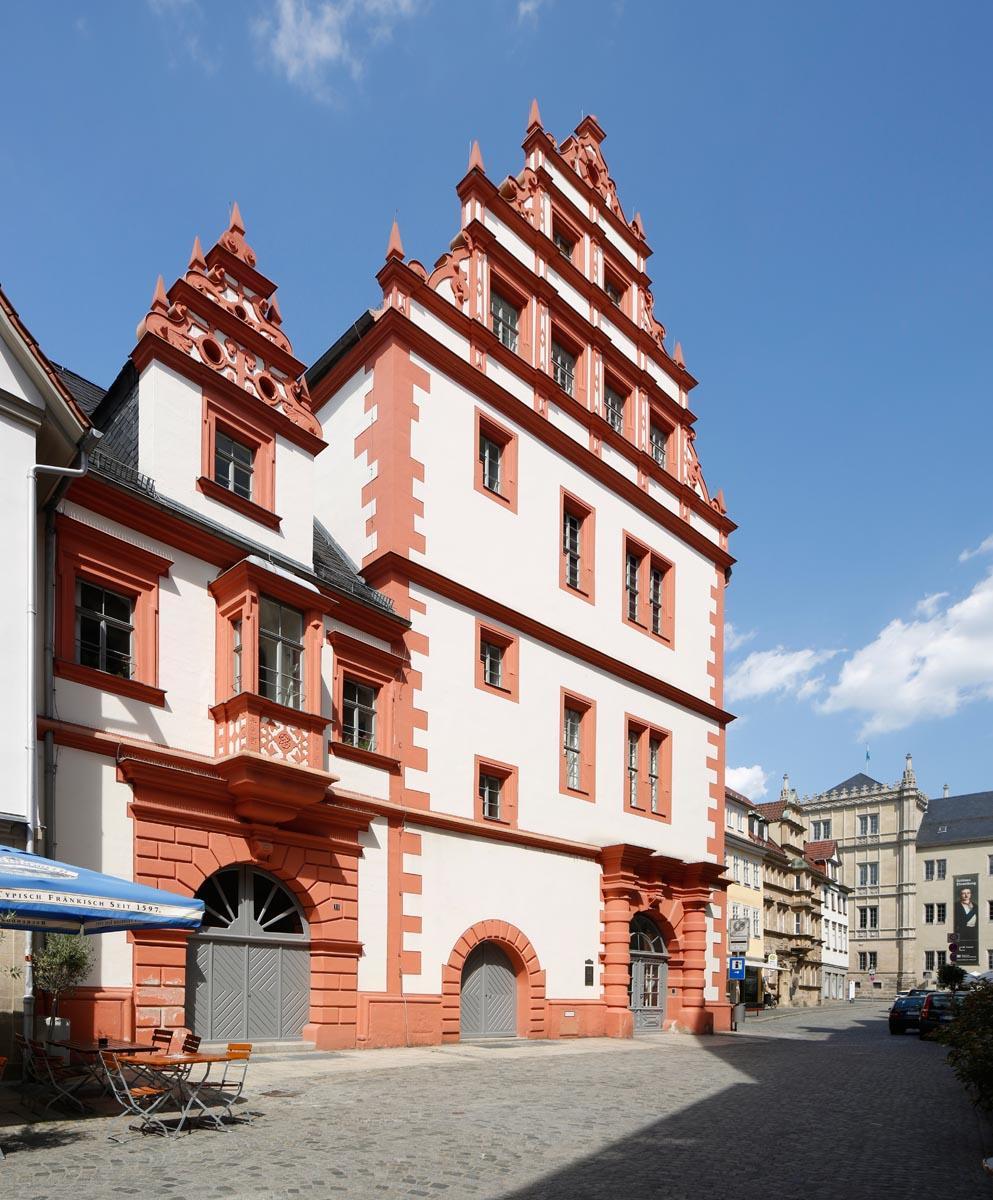
Dr. Johannes Staudenmaier M.A. was effective from 1. July 2022 interimist to the head of State Archives Coburg ordered. He follows Dr. Alexander Wolz M.A., who has been the State Archive since the 21st. December 2017 and was transferred to the state archive Würzburg on 1 September 2021. Johannes Staudenmaier, a native of Munich, studied new history, political sciences and old history at the universities of Bamberg, Madrid and Vienna. He earned his doctorate in the early modern administrative and legislative history of the Hochstifts Bamberg. From 2010 to 2012, Johannes Staudenmaier completed the Bayerische Archivschule in Munich as a lecturer and subsequently worked in the state archives Nuremberg and Bamberg. The State Archive Coburg preserves 419,665 archives of 4.3 km. It is responsible for the archives of the state authorities and courts located in the district-free city of Coburg and in the district of Coburg, even if their jurisdiction extends beyond the territory of the district. The historical tradition extends to the former Duchy of Saxony-Coburg and its forerunners or to the Free State of Coburg, which emerged after the dissolution of the Staff Union of Saxony-Coburg and Gotha in 1919, until its integration into the Free State of Bavaria in 1920. Published on 04.07.2022, supplemented on 08.07.2022

21.03.-20.05.2022: From the national park to the bee colony. 50 years Ministry of the Environment in Bavaria.
The small exhibition “From the National Park to the Beevolksbegehren” shows the diversity of the tradition of the environment stored in the Bavarian Main State Archive. 50 years of the Ministry of the Environment in Bavaria”, which until 20. May 2022 can be seen in the Bavarian Main State Archive. The Bavarian Ministry of the Environment was established in the European Nature Conservation Year 1970 by decision of the Bavarian Landtag. Since then, the environmental policy field has developed into a political-social long-term task with the aim of creating as much as possible equivalent and good living conditions throughout Bavaria. This includes a lively and healthy environment. Priorities in the history of the Ministry of the Environment were early environmental initiatives and educational measures, legislative initiatives such as the inclusion of environmental protection as a state goal in the Bavarian Constitution and the Bavarian Environmental Pact in 1995. There were also challenges such as environmental scandals, protests against the reprocessing plant in Wackersdorf, citizens' initiatives and popular desires. They also demonstrate the emergence of a new political culture of resistance and direct democracy. Place of exhibition: Schönfeldstraße 5, 80539 Munich, 1st floor Opening hours: Monday to Thursday: 8:30 am to 6 pm Friday: 8:30 to 13:30 Sundays and holidays, as well as Easter, 15th to 18th April closed The entrance is free. The exhibition is a catalogue in the series Small exhibitions published: 65: From the national park to the bee colony. 50 years Ministry of the Environment in Bavaria. An exhibition of the Bayerischer Hauptstaatsarchiv, Munich [1 December 2020 - 26.3.2021]. Conception and editing: Johannes Moosdiele-Hitzler, Thomas Paringer (Staatliche Archive Bayerns - Kleine Exhibitions 65), Munich 2020, ISBN 978-3-938831-99-1, 72 pp., numbered sw-Abb. € 4,00. Here is the archiving agreement between the Landesbund für Vogelschutz and the Bayerischer Hauptstaatsarchiv. Posted on 21. March 2022, updated on 26.4.2022.

26.06.2019: "Should and atonement? National Socialism in Court" - Exhibition at the State Archive Coburg
After the Second World War with more than 50 million dead, the question of the responsibility, for the guilt and atonement of the crimes committed by the Nazis, was raised. In addition to the allied war criminal processes in Nuremberg, the Americans led the twelve Nuremberg follow-up processes as well as the Dachauer war criminal processes to punish criminal organisations as well as perpetrator groups and individual workers. Since the end of 1945 the German courts were allowed to speak right again and since 1950 they had so far-reaching competencies in order to be able to judge war crimes. In addition, investigative authorities and courts have now been able to clarify and judge crimes with a national-socialist background. The exhibition at the State Archive Munich provides an insight into the procedures and introduces some processes that stand out from the mass of criminal proceedings. A large section of the exhibition is dedicated to crimes in concentration camps. The legal work-up of Dachau was exclusively within the jurisdiction of the prosecutor's office Munich II, to the Passau outer camps of the concentration camp Mauthausen determined the prosecutor's office Passau. A further section examines the legal work-up of the Nazi violent acts by the Coburg prosecutor's office, as in the Coburger area. The exhibition at the State Archive Coburg (Herrngasse 11) is from 26. June to August 2, 2019 to see. Admission is free. Opening hours: Mo–Do: 8.00–16.00 h, Fr: 8.00–13.30 h A catalogue is available for the exhibition: Small exhibitions No. 40: Guilty and atonement? To prosecute the NS crimes by Upper Bavarian judicial authorities on the basis of the transfer to the State Archive Munich. An exhibition of the State Archive Munich. 6.5.-20.6.2014. Conception and editing: Christoph Bachmann and Robert Bierschneider, Munich 2014, ISBN 978-3-938831-43-4 - € 5.00, 140 pages in text. Download Posted on 26.06.2019

06.03.2020: The State Archive Würzburg participates in the joint day of the Würzburg Archives on Friday 6. March from 14 am to 7 pm.
The 10th day of the archives will be held on the first weekend of March. Several hundred archives in Germany open the doors to their treasury chambers and show their work with historical documents. Archive and Library of the Diocese of Würzburg (ABBW), City Archive Würzburg, State Archive Würzburg and University Archive Würzburg invite you to an event in the archive and library of the Diocese of Würzburg, Domerschulstraße 17. Time: 14:00: welcome, general introduction, short presentation of houses (transmission profile) Announcement of individual programme points (Cramer Hall) 15:00/ 16:00/ 17:00: Introduction Personal research (Reading room) Magazine guide (Magazin) 18:00: Lecture by Prof. Dr. Matthias Stickler, “A Facebook of the Old European University – The masterbook collection of the Würzburg Institute of Higher Education as a source of communication history” (Cramer Hall) 19:00: Event ending Accompanying programme: Foyer: Archival presentation of ABBW on media history Reading room: Possibility of implementing Personal searches (Galerie in the reading room: Information booths Small archives exhibitions of the State Archives, the City Archives and the University Archive on the topics “Archival Sources of Communication History – Selected Examples” (The introduction of this topic will take place at 15/16/17 a.m. through another archive with a view to its stocks) Submitted at: 06.02.2020 Related files: Pressemitteilung Flyer zur gemeinsamen Veranstaltung der Würzburger Archive

25.04.2022: Archiving agreement between the Landesbund für Vogelschutz and the Bayerischer Hauptstaatsarchiv
25. In April 2022, Dr. Bernhard Grau, Director of the Main State Archives and Dr. Norbert Schäffer, Chairman of the Bavarian Association for Bird Protection (LBV), signed an archiving agreement. The agreement regulates the future transfer of the LBV association to the Bayerische Hauptstaatsarchiv. The Landesbund für Vogelschutz is one of the oldest and most important environmental associations in Bavaria. His tradition dates back to the founding year 1909. The new acquisition focus of the Bavarian Main State Archives includes sources from the field of natural, environmental and climate protection as well as civic engagement. The state archives of Bavaria also take over non-governmental and private archives and collections. The written transmission of the Landesbund für Vogelschutz substantially complements the stocks already stored in the Bayerische Hauptstaatsarchiv for environmental and climate protection. The largest group of private traditions form the estates of important personalities: Prof. Dr. Hubert Weiger (born in 1947), forest scientist, long-term chairman and current honorary chairman of BUND Naturschutz in Bayern e.V., BUND and member of the Coal Commission of the Federal Government and many other bodies. He will be present at the signing of the agreement. Dr. Hans Bibelriether (born 1933), Förster, long-term director of the first German National Park “Bayerischer Wald” and a recognized expert in the national park movement. Sepp Daxenberger (1962–2010), Mayor and Minister of State of Bündnis 90/The Greens and their co-country chairman. Ruth Paulig (born 1949), co-founder of the Greens in Bavaria, Minister of State of Bündnis 90/The Greens and their co-country chairman. Dr. Sepp Dürr (born 1953), Chief of State of Bündnis 90/The Greens and their Co-President. Prof. Dr. Klaus Buchner (born in 1941), physicist, Federal Chairman and MEP of the ÖDP. Dr. Max Stiferl (1932–1998), 1970–1977 first Bavarian Minister of the Environment, 1977–1988 Minister of Finance, 1988–1993 Bavarian Prime Minister. Alfred Dick (1927–2005), 1977–1990 Bavarian Environment Minister. The small exhibition “From the National Park to the Beevolksbegehren” shows the diversity of the tradition of the environment stored in the Bavarian Main State Archive. 50 years of the Ministry of the Environment in Bavaria”, which until 20. May 2022 can be seen in the Bavarian Main State Archive. The Bavarian Ministry of the Environment was established in the European Nature Conservation Year 1970 by decision of the Bavarian Landtag. Since then, the environmental policy field has developed into a political-social long-term task with the aim of creating as much as possible equivalent and good living conditions throughout Bavaria. This includes a lively and healthy environment. Priorities in the history of the Ministry of the Environment were early environmental initiatives and educational measures, legislative initiatives such as the inclusion of environmental protection as a state goal in the Bavarian Constitution and the Bavarian Environmental Pact in 1995. There were also challenges such as environmental scandals, protests against the reprocessing plant in Wackersdorf, citizens' initiatives and popular desires. They also demonstrate the emergence of a new political culture of resistance and direct democracy. In about 40 exhibits, the small exhibition will focus on the institutionalization of environmental protection and environmental policy in Bavaria. A small catalogue has been published for the exhibition. The exhibition in the Bavarian Main State Archive, Main Building, Schönfeldstr. 5, can be seen until 20 May 2022. Admission is free. Opening hours: Mo–Do 8.30–18.00 h, Fr 8.30–13.30 h (Sun and holidays closed). Here is the report of the Süddeutsche Zeitung on the archiving agreement. Posted on 20. April 2022, updated on 26. April 2022.

13th Archives Day “Old Home - New Home,” early March 2026
Every two years, the Association of German Archivists (VdA) calls for a nationwide “Archives Day.” Most events take place on the weekend of March 7-8, but some take place earlier. This year, Archives Day will focus on the theme of “Old homeland – new homeland,” but many other topics will also be covered. Among Bavaria's state archives, the Amberg State Archives (presentation already on March 4), the Bavarian Main State Archives, and the Coburg, Landshut, and Munich State Archives will be participating with events on Saturday, March 7. The Augsburg State Archives will take part in “Augsburg open” from May 7 to 10, 2026, and the Bamberg State Archives will hold an open house on June 12. Further information can be found on the Munich archives' joint blog, “Archive in München.” The detailed program for Archives Day at the Bavarian State Archives can be found in the flyer and the accompanying poster. An overview of all participating Munich archives and their programs can be found in the flyer “What? Archives?” Please note: Some events have individual dates or require advance registration. Fig. 1: Exhibition poster for Archives Day; design: Benjamin, Gerum, GDA. Fig. 2: Flyer for “13th Archives Day”; design: Nicole Edwards, GDA. Fig. 3: Flyer “What? Archive?” Participating Munich archives and their program; photo and design: Katharina Kuhlmann, Alfred Küng. Posted on February 12, 2026, modified on February 23, 2026. Related files PM_TdA_2026.pdf Staatliche_Archive_Bayerns_TdA_2026_Flyer.pdf Muenchner_Archive_TdA_2026_Flyer.pdf HStA_TdA_2026_Plakat.jpg StAA_TdA_2026_Plakat.jpg StACo_TdA_2026_Plakat.jpg StALa_TdA_2026_Plakat.jpg StAM_TdA_2026_Plakat.jpg

21.06.2022: More clarity for research. Exchange of archives between the state archives of Bavaria and the archives of the Archdiocese of Munich and Freising
In the Directorate-General of the Bavarian State Archives, an important exchange of archives between the Bavarian State Archives and the Archives of the Munich Archdiocese and Freising was carried out yesterday. Director-General Dr. Margit Ksoll-Marcon and archive and library director Prof. Dr. Johannes Merz gave each other symbolically a total of 543 documents, volumes and files, which will be stored in an archive of the opposite side after they had entered the “false” archive by various historical circumstances. Such a exchange is a technically recognized but not very common approach in archives. Two closed file complexes were submitted to the State Archives from the archbishop archive: 1. Documents of the Foundation administration Wasserburg: The foundation administration is a state authority which, from 1807 to 1817, manages assets and accounts for all churches, brotherhoods and other ecclesiastical foundations in the former Pfleg and/or Landgericht Kling perceived. For this they were also available older series of church bills. In total, it is 146 mostly extensive volumes with invoices of the churches in the parishes of Eggstätt, Eiselfing, Evenhausen, Grünthal, Höslwang, Obing and Schnaitsee from 1700-1803, as well as 78 other volumes and files from 1672-1847. The documents were recovered in 1985 by the archdiocese archives of the parish church of Schnaitsee, where they had arrived on an unknown path. Two. Professors of the Zisterzienserkloster Kaisheim (near Donauwörth): The 96 documents from the period 1575-1727 were mostly written by the novices on parchment, which thus completed their entry into the convent community. At the secularization of the Bavarian monasteries in 1803, they were apparently not taken over by the state archives like the rest of the monastery archives and came to the archive of the archbishop by Deutinger (1789-1854) via the collection of the historically highly interested Munich Cathedral Propstes Martin von Deutinger. The documents submitted by the archive of the archdiocese will be stored in the respective competent state archives and there will be gaps in the tradition: the documents of the foundation administration in the state archive of Munich, the Kaisheimer Professkunde in the state archive of Augsburg. From the state side, a variety of individual items were handed over to the archbishop's archive. In the more detailed analysis of the stocks carried out in the Bavarian Main State Archive in recent years, in which the Freisinger Archivals in the 19th They have turned out to be part of spiritual administration. After the secularization of the Freising High Foundation in 1802, the separation between documents of the spiritual administration that remained with the Freising Diocese Administration and today form the altarpiece of the archbishop's archive, and those of the worldly government of the spiritual principality of Freising, which were taken over by the new landlord with the acquisition of its territories, was not always carried out cleanly, which is now corrected by the exchange of archives. 222 archivals of the spiritual government of the Diocese of Freising (officialate, Spiritual Council or Spiritual Government, Generalvikariat) from 1418-1802 went to the archives of the archdiocese with a very diverse subject. They concern, inter alia, synods, visitations, church court proceedings and monasteries in the diocesan area. The documents handed over to the archive of the archbishop will be incorporated into the corresponding directories in the near future, then scanned and provided online in the digital archive of the archbishop for use. The exchange now completed means a substantial simplification for research. He is also a further proof of the long-standing trusted cooperation between the state archives and the archives of the archbishop, which is shown in the participation of ecclesiastical archives in the training of state archivists and in the joint participation in scientific projects. Posted on 21.06.2022

06.-10.03.2020: 10th national day of archives from 6 to 10. March 2020 under the motto "Communication. From depesche to tweet"
Every two years, the Association of German Archivists (VdA) calls for the "Tag der Archive". There are numerous public and private archives, open their magazines and present their work and stocks. This year the action day is under motto "Communication. From depesche to tweet". It takes place at the beginning of March, mainly at Weekend 7./8. March 2020. The state archives of Bavaria also work on the action day. The Bavarian State Archive (Saturday March 7) and the state archives Amberg (Saturday 7 March), Bamberg (Friday 6 March), Coburg (Monday 9 March), Country hat (Monday 9 March and Tuesday 10. March) and Munich (Saturday March 7) open their doors. The State Archive Würzburg is involved in the joint action day of the Würzburg Archives in the archive and library of the Diocese of Würzburg (Domerschulstr. 7) (Friday 6 March). Lectures, exhibitions and guided tours are offered. Bavarian State Archive - Yeah. Saturday, 7 March 2020, 10.00-17.00 as guest: Archive of the Bavarian Academy of Sciences as guest: Stenographer-Zentralverein Gabelsberger e. V. in Munich State Archive Amberg - Yeah. Saturday, 7 March 2020, 10.00-14.00 State Archive Bamberg - Yeah. Friday, 6. March 2020, 16.00-17.30 State Archive Coburg - Yeah. Monday, 9. March 2020, 18.30 - 20.00 am State Archive Landshut - Yeah. Monday, 9 March 2020 and Tuesday, 10. March 2020 - 16.00 each State Archive Munich - Yeah. Saturday, 7 March 2020, 12.00-19.00 State Archive Würzburg - Yeah. Friday, 6. March 2020, , 14.00 - 19.00 The Staatsarchiv Augsburg takes part in "Augsburg Open" at the end of March together with other Augsburg facilities (https://www.augsburg-city.de/veranstaltungen/augsburg-open). All events on the day of archives, including in other cities and in municipal, ecclesiastical, economic, party and university archives as well as archives of other scientific institutions, can be found on the page https://www.tagderarchive.de/ information. The Bavarian State Ministry of Science and Art has a Press release to the planned events in the state archives. Submitted on: 06.02.2020, added on: 02.03.2020 Related files: Pressemitteilung zum Tag der Archive 2020