
Mehr
![Image1: Sanity Equipment for the Alpine Corps: Skid sledge for the transport of sick into the valley, Signature Bayerisches Hauptstaatsarchiv 1015, Digitalisat-Aufnahme Nr. 78 [Click on picture: ↗Link to the digitalisat in the finder database].](/mam/typo3/user_upload/Medien_fuer_Aktuelles/2022/bild-1_sanitaetsschlitten_bayhsta-alpenkorps-1015-aufnahme-0078.jpg)
15.09.2022: Digitization program NEUSTART CULTURE - Alpenkorps
With its own digitalization project, the Bavarian State Archives participate in NEUSTART CULTURE>>, in which the German Digital Library is also supported. The collection “Alpenkorps” of the department IV (war archive) of the Bavarian Main State Archive was selected. Not only because the “Kommando des Alpenkorps” briefly resided in the premises used today by the departments III and V of the Bavarian Main State Archive in 1915, this inventory is of particular importance for the Bavarian military history. In the spring of 2015, the Alpine Corps was the subject of a teaching exhibition by the Bavarian State Archives. The exhibition catalogue is ANNEX free of charge. When it was set up on the occasion of the war in Italy in 1915, the Alpine Corps was a new special military unit, since until that time the German Empire had no troops for the mountain struggle. The unit belonged to several elite troops of the Empire, including the Bavarian Infantry Legacy Regiment. More than half of the units of the Alpine Corps consisted of Bavarian troops.Some later officers of the Wehrmacht, but also leading National Socialists sometimes belonged to the alpine corps. Examples are only Erwin Rommel, Heinz Guderian, Ferdinand Schörner or Franz Ritter von Epp. The unit, contrary to its name, was not only used on the “Alpenfront” but was also used on the western and eastern fronts, e.g. in the “Schacht bei Hermannstadt” in Romania in September 1916. With the exception of a small number of documents that had to be reset by digitalization for conservation reasons, the entire inventory was digitized. It includes over 1840 files (about 42 running meters). A total of 307,655 images were produced. All areas of the corps are covered over the entire period of its existence. The following are mentioned by way of example: war diaries, chief shares, documents from departments Ia (Operative and Tactical) and Id (news officer), department III (field officer), the medical field (Korps doctor, Corps veterinarian) or also the area of postponement, stage and settlement. Digitization was made possible by the German Digital Library within the framework of the "Restart Culture" programme funded by the Federal Government Commissioner for Culture and Media (BKM). BKM: www.kulturstaatsministerin.de NK: https://neustartkultur.de DDB: https://www.deutsche-digitale-bibliothek.de/ You can find the digitized inventory of Alpenkorps in the online database of the Bavarian State Archives ANNEX Link to the publication of the data at the DDB/Archivportal D: Bayerischer Hauptstaatsarchiv, Alpenkorps>> Published on 15.09.2022, supplemented on 19.12.2022

27.2.-26.5.2023: Vaccines in Bavaria at the beginning of 20. Century
The small teaching exhibition "Impfgegner in Bavaria at the beginning of the 20th century from 27 February to 26 May in the State Archive Munich. Kevin Beesk's exhibition was launched as part of the current preparation service 2021/2024 for the start in the 3rd. Qualification level of the field of education and science, specialized focus on archives at the University of Applied Sciences in Bavaria, was developed from the 7th January to 7 Feburar in the Bavarian Main State Archive. Vaccinary scepticism and vaccination are not phenomena of the corona pandemic and associated discussions about vaccines or a general vaccination obligation. There have been reservations and resistance to vaccinations since the end of the 19th century. Century. The impfgegneric movement in the German Reich experienced a spy supply, especially since the introduction of a general vaccination obligation against the Pocken 1874. The small exhibition takes a look at the impfgegneric movement, its activity in Bavaria and main actors at the beginning of the 20th century. The nearly 30 exhibits originate mainly from the collections of the Bavarian State Archives. The Bayerische Staatsbibliothek and the German Medical History Museum in Ingolstadt have provided digitalisate. accompanying the exhibition is a booklet available on this page under 'Family' files and under Publications available for download. Digitalized archives for exhibition: Exhibition 23: BayHStA, MK 16653: Dr. Heinrich Molenaar, Personalakt (412 Digitalisate) >> Opening hours: Monday to Thursday: 8:30 am to 4 pm Posted on 17.01.2023

21.06.2022: Cooperation Agreement between the University of the Federal Armed Forces of Munich and the Directorate-General for State Archives of Bavaria signed
21. In June 2022, the President of the University of Bundeswehr Prof. Dr. Merith Niehuss, whose Vice President Prof. Dr. Uwe Borghoff and the Director-General of the State Archive Dr. Margit Ksoll-Marcon signed a cooperation agreement at the University of the Bundeswehr Munich. The aim is to co-operate the Institute of Software Technology and the datArena of the University of the Bundeswehr Munich with the state archives of Bavaria in data backup and long-term data storage. The contract includes the cooperation of the two institutions with the organization and support of student projects and internships in order to close students with forms, methods and instruments of archival information management, as well as to give insights into the field of archives and the challenges of digital long-term archiving. Focus: Recovering old records and long-term archiving The intention of the agreement is that both partners develop joint projects, scientific meetings and workshops. For this purpose, the stock of the Bavarian State Archives can be used for research purposes by students and lecturers of the Institute for Software Technology. Research projects as well as project or master's work are intended primarily to restore and interpret older data stocks of the Bavarian State Archives, document formats and digital long-term storage and long-term preservation. Software solutions that can be created in research and used for the purposes of archiving are released for use by the State Archives. “The cooperation with the state archives is of particular importance for the University of the Bundeswehr Munich and the work in the datArena. This gives our researchers access to authentic and historically valuable data material as well as close personal contacts to internationally identified experts of long-term digital archiving,” explains Prof. Dr. Borghoff. Dr. Ksoll-Marcon said: “Enge contacts to the Institute of Software Technology at the University of the Bundeswehr have existed for many years and are intensified by this cooperation. The aim is to make research data readable and usable and to further develop the necessary technologies." The datArena: A forum of encounter The signing of the cooperation agreement took place in the new premises of the datArena on the grounds of the University of the Bundeswehr Munich. The datArena is a teaching, research and exhibition centre that conveys between technical, cultural and social history and will also offer researchers, students and the public a forum for encounters. The datArena was founded jointly by Prof. Dr. Borghoff and John G. Zabulitzky. At present, a move on the grounds is completed. In addition to valuable, technology-historical, representative electronic computers, the datArena houses a software archive of international rank and one of the largest collections of historical digital media. Since the software and media can be used on functional devices from the respective era, historical software and digital documents can be brought back to life. Thus, datArena offers an excellent infrastructure for research in the field of digital long-term archiving and preservation of digital cultural heritage. In conjunction with the datArena, courses and internships of the Bayerische Archivschule will be organized and conducted in the future.

01.08.2022: Bayerisches Hauptstaatsarchiv acquires collection to the Bayreuth Festival
Bayerisches Hauptstaatsarchiv acquires collection to the Bayreuth Festival Since its foundation by Richard Wagner in 1876, the Bayreuth Festival has been one of Bavaria's outstanding cultural events with international broadcasting. After laborious years of construction and a phase of ideological segregation by the National Socialists, a new beginning was achieved after World War II. The Bayreuth Festival has been attracting political and social prominence every year since 1951. The Bavarian State Archive has now been able to acquire an extensive private collection of the Bayreuth Festivals from the post-war period. For the post-war period, the collection stock formed from it and from existing material includes all the program books of the Festival, accompanying publications such as the “Festspiel Preview” and the “Festspiel News” and other printed material that often has rarity value. The press sections and photo albums contained are of particular importance. The photo albums not only combine the official role and stage photos, but also complement them with private recordings from the social environment and the inner circle of artistic actors. In addition to the national and partly international press, the press sections also take into account the rest of the German-speaking press. The media echo of the Bayreuth Festival is thus gathered in a number of times – from pre-reporting on current reviews and reports to review. In the cultural sector – unlike in politics – there are often few official sources and usually fewer private sources. In addition, discourses were often medial. Therefore, the delivery of press in the cultural sector is of particular quality. The dense delivery to press clips in the Bayreuth Festival Collection is therefore a special lucky case. The documents were collected by Willy Wesemann (1910–1985). The violinist was a member of the Festival Orchestra for decades and was therefore closely related to all artistic participants. As an enthusiastic collector, he took great effort. During the festive season, he referred to the most important press organs himself and advertised them for his collection, as well as photographed himself. All press cutouts were finely cut, provided with source information and stored clean. His whole family was involved in these works. His daughter Astrid Zimdahl-Wesemann has now left the collection of about three shelves to the Free State of Bavaria. The new “Bayreuth Festival Collection” complements the existing collections of the Bavarian Main State Archive with reference to the Bayreuth Festival. In addition to the state tradition mainly from the Ministry of Culture, this is mainly the two estates of Wieland and Wolfgang Wagner. In their time, both of them were decisive for the Bayreuth Festival and the opera world as a whole. The Bayerische Hauptstaatsarchiv is the central archive of the Free State of Bavaria and one of the largest archives in Germany. In addition to official documents, it also retains non-state archives. These include in particular estates of important personalities and collections.

25.04.2022: Archiving agreement between the Landesbund für Vogelschutz and the Bayerischer Hauptstaatsarchiv
25. In April 2022, Dr. Bernhard Grau, Director of the Main State Archives and Dr. Norbert Schäffer, Chairman of the Bavarian Association for Bird Protection (LBV), signed an archiving agreement. The agreement regulates the future transfer of the LBV association to the Bayerische Hauptstaatsarchiv. The Landesbund für Vogelschutz is one of the oldest and most important environmental associations in Bavaria. His tradition dates back to the founding year 1909. The new acquisition focus of the Bavarian Main State Archives includes sources from the field of natural, environmental and climate protection as well as civic engagement. The state archives of Bavaria also take over non-governmental and private archives and collections. The written transmission of the Landesbund für Vogelschutz substantially complements the stocks already stored in the Bayerische Hauptstaatsarchiv for environmental and climate protection. The largest group of private traditions form the estates of important personalities: Prof. Dr. Hubert Weiger (born in 1947), forest scientist, long-term chairman and current honorary chairman of BUND Naturschutz in Bayern e.V., BUND and member of the Coal Commission of the Federal Government and many other bodies. He will be present at the signing of the agreement. Dr. Hans Bibelriether (born 1933), Förster, long-term director of the first German National Park “Bayerischer Wald” and a recognized expert in the national park movement. Sepp Daxenberger (1962–2010), Mayor and Minister of State of Bündnis 90/The Greens and their co-country chairman. Ruth Paulig (born 1949), co-founder of the Greens in Bavaria, Minister of State of Bündnis 90/The Greens and their co-country chairman. Dr. Sepp Dürr (born 1953), Chief of State of Bündnis 90/The Greens and their Co-President. Prof. Dr. Klaus Buchner (born in 1941), physicist, Federal Chairman and MEP of the ÖDP. Dr. Max Stiferl (1932–1998), 1970–1977 first Bavarian Minister of the Environment, 1977–1988 Minister of Finance, 1988–1993 Bavarian Prime Minister. Alfred Dick (1927–2005), 1977–1990 Bavarian Environment Minister. The small exhibition “From the National Park to the Beevolksbegehren” shows the diversity of the tradition of the environment stored in the Bavarian Main State Archive. 50 years of the Ministry of the Environment in Bavaria”, which until 20. May 2022 can be seen in the Bavarian Main State Archive. The Bavarian Ministry of the Environment was established in the European Nature Conservation Year 1970 by decision of the Bavarian Landtag. Since then, the environmental policy field has developed into a political-social long-term task with the aim of creating as much as possible equivalent and good living conditions throughout Bavaria. This includes a lively and healthy environment. Priorities in the history of the Ministry of the Environment were early environmental initiatives and educational measures, legislative initiatives such as the inclusion of environmental protection as a state goal in the Bavarian Constitution and the Bavarian Environmental Pact in 1995. There were also challenges such as environmental scandals, protests against the reprocessing plant in Wackersdorf, citizens' initiatives and popular desires. They also demonstrate the emergence of a new political culture of resistance and direct democracy. In about 40 exhibits, the small exhibition will focus on the institutionalization of environmental protection and environmental policy in Bavaria. A small catalogue has been published for the exhibition. The exhibition in the Bavarian Main State Archive, Main Building, Schönfeldstr. 5, can be seen until 20 May 2022. Admission is free. Opening hours: Mo–Do 8.30–18.00 h, Fr 8.30–13.30 h (Sun and holidays closed). Here is the report of the Süddeutsche Zeitung on the archiving agreement. Posted on 20. April 2022, updated on 26. April 2022.

21.06.2022: More clarity for research. Exchange of archives between the state archives of Bavaria and the archives of the Archdiocese of Munich and Freising
In the Directorate-General of the Bavarian State Archives, an important exchange of archives between the Bavarian State Archives and the Archives of the Munich Archdiocese and Freising was carried out yesterday. Director-General Dr. Margit Ksoll-Marcon and archive and library director Prof. Dr. Johannes Merz gave each other symbolically a total of 543 documents, volumes and files, which will be stored in an archive of the opposite side after they had entered the “false” archive by various historical circumstances. Such a exchange is a technically recognized but not very common approach in archives. Two closed file complexes were submitted to the State Archives from the archbishop archive: 1. Documents of the Foundation administration Wasserburg: The foundation administration is a state authority which, from 1807 to 1817, manages assets and accounts for all churches, brotherhoods and other ecclesiastical foundations in the former Pfleg and/or Landgericht Kling perceived. For this they were also available older series of church bills. In total, it is 146 mostly extensive volumes with invoices of the churches in the parishes of Eggstätt, Eiselfing, Evenhausen, Grünthal, Höslwang, Obing and Schnaitsee from 1700-1803, as well as 78 other volumes and files from 1672-1847. The documents were recovered in 1985 by the archdiocese archives of the parish church of Schnaitsee, where they had arrived on an unknown path. Two. Professors of the Zisterzienserkloster Kaisheim (near Donauwörth): The 96 documents from the period 1575-1727 were mostly written by the novices on parchment, which thus completed their entry into the convent community. At the secularization of the Bavarian monasteries in 1803, they were apparently not taken over by the state archives like the rest of the monastery archives and came to the archive of the archbishop by Deutinger (1789-1854) via the collection of the historically highly interested Munich Cathedral Propstes Martin von Deutinger. The documents submitted by the archive of the archdiocese will be stored in the respective competent state archives and there will be gaps in the tradition: the documents of the foundation administration in the state archive of Munich, the Kaisheimer Professkunde in the state archive of Augsburg. From the state side, a variety of individual items were handed over to the archbishop's archive. In the more detailed analysis of the stocks carried out in the Bavarian Main State Archive in recent years, in which the Freisinger Archivals in the 19th They have turned out to be part of spiritual administration. After the secularization of the Freising High Foundation in 1802, the separation between documents of the spiritual administration that remained with the Freising Diocese Administration and today form the altarpiece of the archbishop's archive, and those of the worldly government of the spiritual principality of Freising, which were taken over by the new landlord with the acquisition of its territories, was not always carried out cleanly, which is now corrected by the exchange of archives. 222 archivals of the spiritual government of the Diocese of Freising (officialate, Spiritual Council or Spiritual Government, Generalvikariat) from 1418-1802 went to the archives of the archdiocese with a very diverse subject. They concern, inter alia, synods, visitations, church court proceedings and monasteries in the diocesan area. The documents handed over to the archive of the archbishop will be incorporated into the corresponding directories in the near future, then scanned and provided online in the digital archive of the archbishop for use. The exchange now completed means a substantial simplification for research. He is also a further proof of the long-standing trusted cooperation between the state archives and the archives of the archbishop, which is shown in the participation of ecclesiastical archives in the training of state archivists and in the joint participation in scientific projects. Posted on 21.06.2022

25.07.2022: Agreement for Mutual Support of Würzburg Archives Signed in Emergency
Director-General of the State Archives, Dr. Margit Ksoll-Marcon, the General Vicar of the Diocese of Würzburg, Dr. Jürgen Vorndran, the Cultural and Tourist Office of the City of Würzburg, Mr Achim Könneke, the Head of the Archives of the Julius-Maximilians-University of Würzburg, Dr. Marcus Holtz, signed on 25. July 2022 the agreement on mutual support for Würzburg archives in emergencies (“Notfallverbund Würzburg”). For the hopefully never-ending emergency, the institutions provide mutual support to bundle resources and to ensure faster and more effective recovery and initial supply of the affected archives, books and exhibits. For the institutions involved, the protection of the cultural goods they hold against fire, water, external violence or other unpredictable events is one of the most important tasks. The past has shown that the staff of the individual institutions are often overwhelmed without external assistance, which has shown impressively large disasters such as the Elbhochwasser 2002, the fire in the Weimar Anna-Amalia-Bibliothek 2004 or the collapse of the historical archive of the city of Cologne 2009. The Würzburg emergency association, established by the signing of this agreement, expressly invites the representatives of other cultural institutions in the Würzburg district to cooperate in the future. With the establishment of the emergency association Würzburg, the state archives of Bavaria have come a big step closer to their goal of establishing an emergency network at each archive location. Only the state archive Coburg is not yet integrated. Allies include Würzburg in Augsburg, Munich, Amberg-Sulzbach-Rosenberg, Bamberg, Nuremberg and Landshut. Further information on the work of emergency associations in Germany can be found at: http://notfallverbund.de/

02.06.2022-15.07.2022: Act and songbook. Church and State in Central France
The Landeskirchliche Archiv der Evangelisch-Lutherischen Kirche in Bayern (LAELKB) and the Staatsarchiv Nürnberg will present a joint exhibition at LAELKB from 2 June to 15 July 2022. Since spring 2020, during the renovation and expansion of its buildings in Archivstraße 17, the State Archives has sold most of the collections before 1800 in rented LAELKB magazines. A part of the exhibits is therefore temporarily under a roof. In view of the two archivists, a discussion of the relationship between the Church and the State was offered as a topic. The Landeskirchliche Archiv preserves church documents from the entire Free State. The State Archive Nuremberg is responsible for the written delivery of the state authorities and courts in Central Franconia. Therefore, we have spatially limited the subject: "Church and State in Central Franconia". The exhibits range from the Reformation period to the present. In selected examples, both mutual proximity and conflicts between state and church are clear. For example, in the introduction of the Reformation, in the 18th century, there is a closeness to the process of reforming. Centuries in the construction of numerous churches in the Markgraftum Brandenburg-Ansbach, which are today called Markgrafenkirchen, as well as after 1800 in schools and in the participation of the pastors in vaccinations. Conflicts occurred both in the age of absolutism with the lifelong imprisonment of an Anglo-Saxon court preacher and confessor as well as in the time of the Nazi dictatorship with prison sentences against priests because of statements that seem rather harmless from today's point of view. There were also frictions during the transition of Franconian territories to the Kingdom of Bavaria after 1806. Place of destination: Landeskirchliche Archiv der ELKB, Veilhofstraße 8, 90489 Nürnberg Opening hours: Monday to Wednesday 9-17, Thursday 9-20, Friday 9-13. The richly illustrated exhibition catalogue (116 pages) costs 7.50 euros and can be obtained via the Landeskirchliche Archiv (archiv@elkb.de). Guided tours can also be via Archive@elkb to be agreed.
01.07.2022: New office management in the state archive Coburg
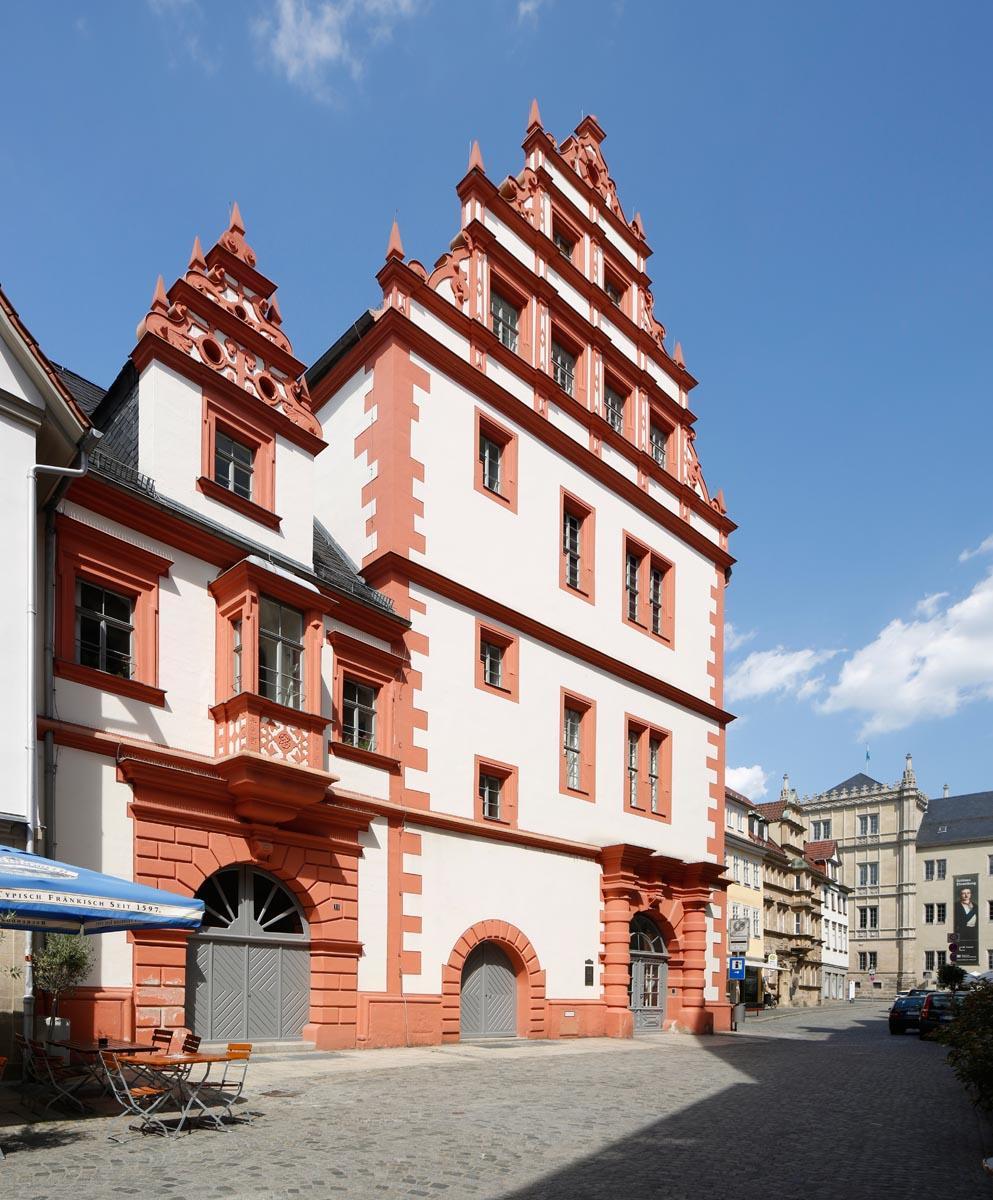
Dr. Johannes Staudenmaier M.A. was effective from 1. July 2022 interimist to the head of State Archives Coburg ordered. He follows Dr. Alexander Wolz M.A., who has been the State Archive since the 21st. December 2017 and was transferred to the state archive Würzburg on 1 September 2021. Johannes Staudenmaier, a native of Munich, studied new history, political sciences and old history at the universities of Bamberg, Madrid and Vienna. He earned his doctorate in the early modern administrative and legislative history of the Hochstifts Bamberg. From 2010 to 2012, Johannes Staudenmaier completed the Bayerische Archivschule in Munich as a lecturer and subsequently worked in the state archives Nuremberg and Bamberg. The State Archive Coburg preserves 419,665 archives of 4.3 km. It is responsible for the archives of the state authorities and courts located in the district-free city of Coburg and in the district of Coburg, even if their jurisdiction extends beyond the territory of the district. The historical tradition extends to the former Duchy of Saxony-Coburg and its forerunners or to the Free State of Coburg, which emerged after the dissolution of the Staff Union of Saxony-Coburg and Gotha in 1919, until its integration into the Free State of Bavaria in 1920. Published on 04.07.2022, supplemented on 08.07.2022