

Use and advice after prior registration
Because of the limited number of jobs in the reading room and for organizational reasons, we ask for a pre-registration. Please let us know if you need the place only in the morning or in the afternoon or all day (Monday – Thursday). For the timely submission of the archives we recommend to preorder these at least 24 hours (working day) before the visit.
We also ask to note that several stocks are outsourced in a depot that is only raised once a week.
In the reading room of the Amberg State Archives Users also create digital photographs from archives. Further information on the conditions can be found in the Use notes.
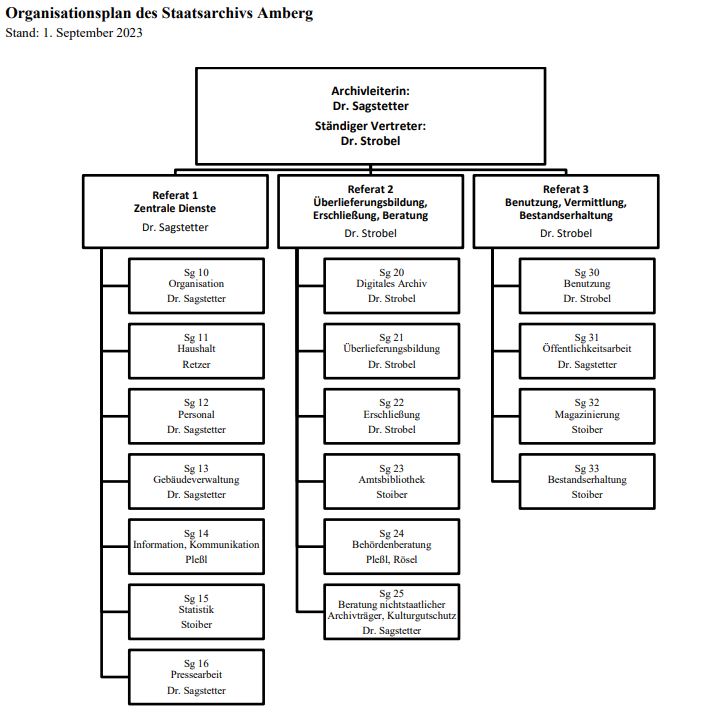
Director: Archive Director Dr. Maria Rita Sagstetter M.A.
Sprengel: Government district Oberpfalz
Stocks:
- Principality of the Upper Palatinate including the monasteries located in it
- Landgrafschaft Leuchtenberg
- Principality of Pfalz-Sulzbach
- the richly insensible dominations located in the Sprengel
- the Pfalz-Neuburgian offices, dominations and court marks on the Nordgau
- The Bayerische Hauptstaatsarchiv is responsible for the Reichsstadt Regensburg and the pens and monasteries located in it.
- State central and lower authorities as well as courts in the administrative district of Oberpfalz from the beginning of 19. Century.
Click on the box Online finders and online digitalisates on the Home of the State Archives you get access to the Online Findings of the State Archive Amberg and the digitized documents.
Volume: 27.278 lfm with approximately 3,31 million archive units (as at 31. December 2024).
Transport:Bus line 404 "Bahnhof Obere Hockermühle", stop Archivstraße directly near the entrance. The bus is half-hour.
Virtual reading room:
Click here to access the virtual reading room of the Bavarian State Archives.
The State Archive Amberg is the state authority for all questions of archives in the administrative district of Oberpfalz.
The modern Sprengel is built in 1837 by the administrative district of Oberpfalz in its current extension, modified by the territorial reform of 1972, with its predecessors, the circles in today's Oberpfalz (since 1808). The documents of various central authorities, located at the headquarters of the government of the Oberpfalz in Regensburg, which were or are responsible for the two government districts of Oberpfalz and Niederbayern-Oberpfalz, such as the administrative court Regensburg, the former police presidium Niederbayern-Oberpfalz, the former forest director Niederbayern-Oberpfalz, the former Oberpostdirektion Regensburg, and the former railway director Regensburg.
The responsibility of the State Archive for historical documents from the period of the Old Reich extends to the Principality of the Upper Palatinate, including the monasteries located in it, as well as the Landgrafschaft Leuchtenberg, the Principality of Pfalz-Sulzbach, several richly immeasurable dominations, and to the imprisonable dominations situated in the Northgau.
The boundaries of today's administrative districts are becoming In the case of the monastery of Weißenohe, Fichtelberg, Rothenberg and Büchenbach, Hartenstein and Schnaittach as convolutions of the Principality of the Upper Palatinate, as well as the Pfalz-Neuburgian offices on the Nordgau Allersberg, Heideck and Hilpoltstein, all of which fall within the competence of the State Archives.
The archives and the registratures of offices and institutions of the Hochstiften Bamberg (Stadt und Amt Vilseck: im Staatsarchiv Bamberg), Eichstätt (Stadt und Amt Berching, Kloster Plankstetten: im Staatsarchiv Nuremberg) and Regensburg (total tradition including the offices of Donaustauf, Hohenörburg am Nordgau. State Archive Nuremberg), the pfalz-Neuburgan monasteries Pettendorf and Pielenhofen (in the Bayerisches Hauptstaatsarchiv or in the Staatsarchiv Augsburg) as well as to the Kurbayerische Rentmeisteramt Munich or the Straubing belongs Altmannstein and Riedenburg (Staatsarchiv München), Cham, Dietfurt, Furth im Wald, Haidau and Pfatter, Kötzting and Stadtamhof (Staatsarchiv Landshut) with the monasteries Frauenzell, Prüfening, Prüll and Stadtamhof-St. Mang (Bayerisches Hauptstaatsarchiv).
The collections of the State Archives currently comprise approximately 3,21 million archiving units (AE) in the amount of 26,297 running meters (lfm) distributed to the magazines in the main building in Amberg and in the outskirts of Sulzbach-Rosenberg. The annual increase is about 350 metres, mainly due to the levies of the authorities, courts and other public authorities of the Free State of Bavaria.
The use depends on the usage order for the state archives of Bavaria of 16th. January 1990 (GVBl p. 6) in the valid version, in which the use fees are also regulated.
The Amberg State Archives grew from the archives and the registratures of the Amberg government authority of the Kurpfälzische until 1621 and Kurbayerische Fürstentums der Oberen Pfalz from 1621/28. In 1436, the arch of the letter of the Amberger firm, whose oldest catalogue of documents dates back to 1457. Archive of documents and registrature of the firm of the part-Duchy of Pfalz-Neumarkt up to 1499 were completed after completion of the new Amberger firm or firm. Government building transferred to Amberg in 1547 and merged with the archive and registrature of the Amberger firm. Since about 1570 the management of archives and registrature has been a government director since the outgoing 17th. Century a government archive. The name “Regulation Archive” for the archive of documents and government registration has been published since 18th. century familiar.
In 1650 and the Principality of Pfalz-Sulzbach in 1791, the government of Amberg brought significant increases in competence. By the formation of the “Province Oberpfalz” from the principalities Upper Palatinate and Pfalz-Sulzbach as well as the Landgrafschaft Leuchtenberg in 1799, the Amberger government archive was passed to the “Landesarchiv” of this province, which, last referred to as the “Bayerisches Landesarchiv der Oberen Pfalz” until 1812.
After the Bavarian archival organization of 1812, the Upper Palatinate National Archives was reduced to an archive conservatory and subordinated to the General Reichsarchiv in Munich, to which extensive extraditions took place in the following years. Between 1820 and 1837 it was only a depot registration of the Regensburger Kreisverwaltung. In 1841 it was re-founded as an archive conservatory and renamed as all Bavarian regional archives in “Kgl. Kreisarchiv” in 1875. It now grew into the function of a Sprengelarchive, which was responsible for the releases of all state authorities in the government district.
The archive (since 1921 ‘Bayerisches Staatsarchiv Amberg’, since 1970 ‘Staatsarchiv Amberg’) has also received a firm responsibility for the historical holdings as part of the total Bavarian stock purification carried out on the basis of the provenance principle, especially since 1974. The Oberpfälzer and Leuchtenberger Stocks, which were centralized in Munich after 1812, were returned successively to Amberg between 1986 and 2003 (including the entire Upper Palatinate Archive, the registrature books of the Amberger and Neumarkt-Neunburger Fürstenkanzleien, the plan collection of the Amberger Government, Leuchtenberger Archivalien as well as the most recent collections). Further purifications took place with the state archives Nuremberg, Bamberg, Neuburg a. d. Donau and Landshut and will still be carried out with the Bavarian Main State Archive (there are further accesses from the inventory “Gerichtsversicherungs” which has not yet been analyzed in the Bavarian Main State Archive for final analysis regarding the dishes in the Oberpfalz).
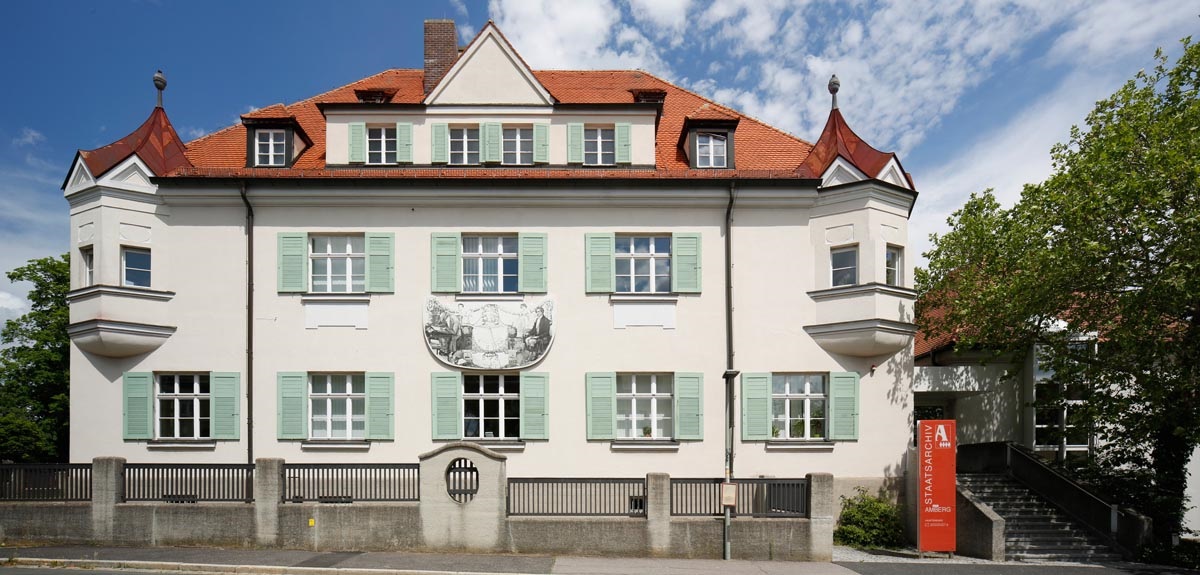
The archive (Brief vault) mentioned for the first time in 1436 was housed in Amberger Schloss, built after 1417. Another arch of the letter had the firm of the Neumarkter Pfalzgrafen. When in 1547 the new government law firm in Amberg was able to be purchased, both archives were combined. Since the end of the 16th The documents were kept in a space of the Fuchssteiner Tower of the Amberger Castle, where they remained until 1812. In 1596 and 1601 two private buildings adjacent to the north were purchased for the better accommodation of the main government register stored on the roofs of the government office, structurally connected with the government office and expanded to form a “archive”. In connection with the abolition of the Sulzbach government in 1791 and the transfer of Sulzbach registrar judgements to Amberg, parts of the government archive or government register were transferred from the government office to the neighbouring pension master's office building. The dramatically growing space in the 19th century was fixed in 1910 by the construction of today's archive building on the archival street. In the 1970s of the 20. The document space of the State Archive was once again exhausted and an extension was urgently required. After a controversial discussion whether the State Archive should not be moved to Regensburg as the seat of the government and the university, a decision by the Bavarian Council of Ministers of May 1979 Amberg continued to be the seat of the archive and thus linked the commitment of spatial extensions. On this basis, large-scale conversion and extensions were carried out in the magazine and public sectors between 1984 and 1987. In addition, the so-called Schlosskaserne in Sulzbach-Rosenberg has set up an exterior which offers additional magazine areas and functional spaces.
The holdings of the Amberg State Archives can be found here.
The official library of the State Archives, which is available to the users as a presence library, currently comprises approximately 34,600 volumes, including 16,000 magazine volumes, and a collection of 2,000 special prints. The Bavarian and Upper Palatinate state, regional and local history as well as the history of Bohemia and the Egerland as the immediate neighbor of the Oberpfalz are the focal points. The official pages of the authorities and the printed annual reports of the schools are also part of the library, both up to the beginning of 19. to date. The delivery of the daily newspapers has greater gaps, especially for the time of the Third Reich.
Publications about the Amberg State Archives can be found here.
You can find the virtual tour of the State Archives here: Start tour
Address
Archivstr. 3, 92224 Amberg
Contact
Tel. 09621/307911 Fax 09621/307907 E-Mail: poststelle@staam.bayern.de
Management
Archivist Dr. Maria Rita Sagstetter M.A.