

Use and advice
The Bamberg State Archive is available at any time for consulting and use purposes at the mentioned opening hours.
A pre-registration for the reading room is not absolutely necessary, but is strongly recommended for reasons of targeted and effective preparation and execution of their visit.
In the reading room of the Bamberg State Archives Users also create digital photographs from archives. Further information on the conditions can be found in the Use notes.
Head: Archive director Dr. Klaus Rupprecht
Sprengel: District of Oberfranken (without a circular town and district of Coburg)
Stocks:
- The territories located in the eastern part of the former Franconian Reich Circle, in particular the Hochstift and Domkapitel Bamberg and the Markgraftum Brandenburg-Kulmbach-Bayreuth.
- State central and lower authorities as well as courts in the Upper Franconia government district from the beginning of 19. Century.
Click on the box Online finders and online digitalisates on the Home of the State Archives you get access to the
Online Findings of the Bamberg State Archive or to the digitized holdings.
Volume: 27.925 lfm. with approximately 2.7 million archive units (as at 31 December 2024).
Transport: From Bamberg station with bus lines 901, 902, 911, 914, 931, 935 two stations to the Central Bus Station (ZOB). There change to bus line 909 (half hour) or 15 minutes on foot.
Virtual reading room:
Click here to access the virtual reading room of the Bavarian State Archives.
The State Archive Bamberg is the state authority responsible for all questions of archival in the Bavarian government district of Oberfranken (with the exception of the city and the district of Coburg). As a historical blast, it is assigned to it the territories located in the eastern part of the Franconian Reichskreis - in particular the Hochstift Bamberg and the Markgraftum Brandenburg-Kulmbach-Bayreuth - which are at the beginning of the 19th century. They fell to Bavaria for centuries.
The state archive currently comprises approximately 2.7 million archive units, including approximately 75,000 documents and 18,000 maps and plans. The entire circumference is almost 28,000 running meters (lfm).
The use depends on the use order for the state archives of Bavaria of 16.1. 1990 (GVBl p. 6), which also regulates the use fees.
The most important transfer agents for the Bamberg State Archive are for the period before 1803 or 1810 the large Reichsstands (Hochstift Bamberg, Markgraftum Brandenburg-Kulmbach-Bayreuth), the wealthless Reichsritterschaft (Kantone Gebirg and Steigerwald) and the Franconian Circle, for the 19th and 20th. century the Bavarian state authorities as well as federal and federal authorities of the middle and lower administrative levels. In 1812, the archive of the former high-rise foundation Bamberg in the Neuen Residenz was assigned to the kgl. From 1813 to 1818, the Bayreuther and the Plassenburger Archive came to Bamberg between 1813 and 1818, where they were stored next to the episcopal secret registration in the repealed Carmelite monastery. In the following period, these archive bodies were combined with the archive in the New Residence. It was in 1852 kgl. Archive Conservatory renamed, 1875 in kgl. District Archive Bamberg; since 1921 it bears the name State Archive Bamberg.
The documents extracted to the General Reichsarchiv (now: Bayerisches Hauptstaatarchiv) in Munich in the 19th century before 1401 were returned to Bamberg in 1993.
Extraditions left behind in the striking archives since the second half of the 16th. in Ansbach, after the seizure of both principalities in Prussia in 1792 and in particular as a result of the war of 1866, marked traces; the house and family objects delivered to Prussia after the Prague peace in 1867 are now in the secret state archive in Berlin-Dahlem (formerly in the Merseburg department of the Central State Archive of the GDR).
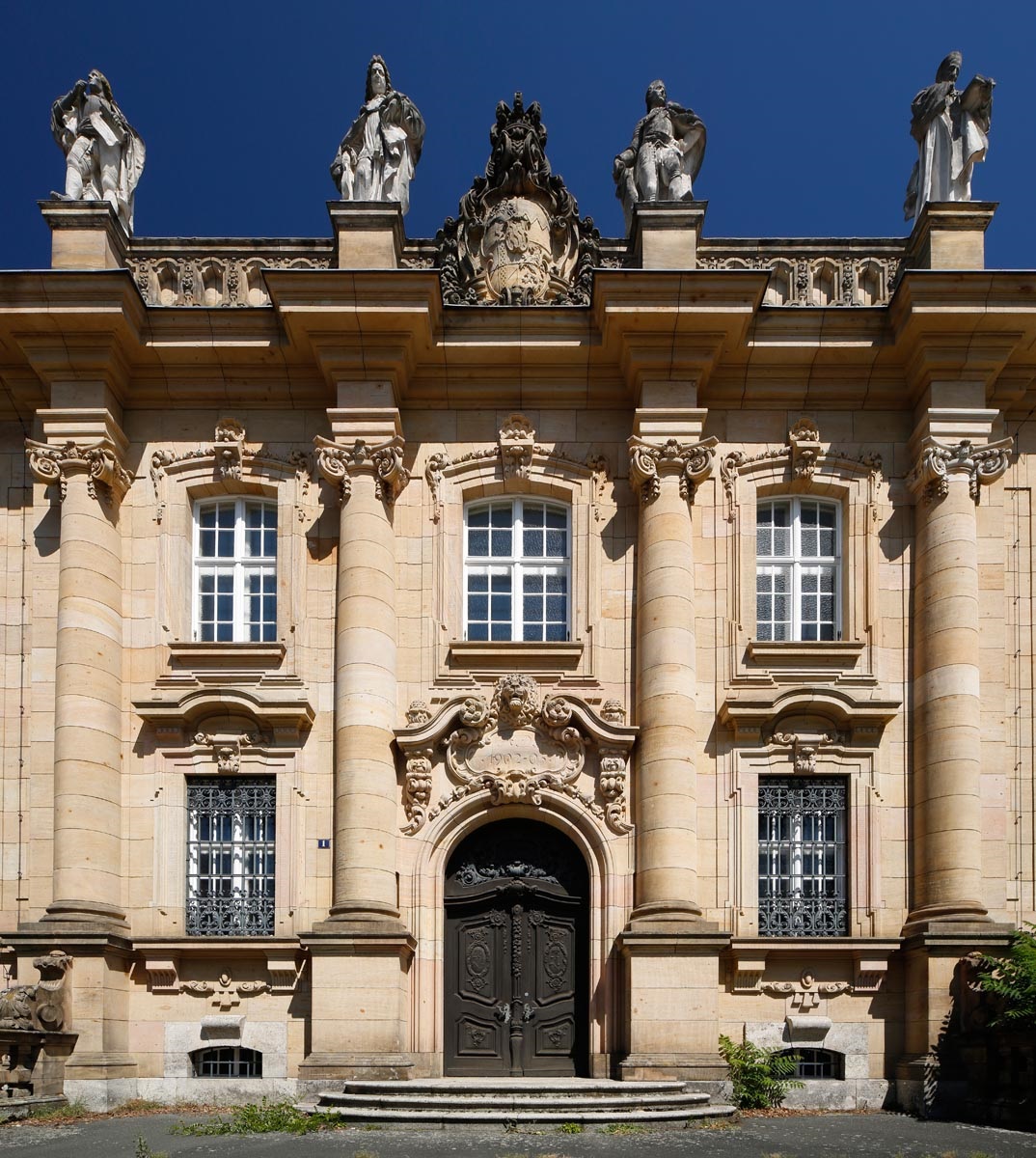
The newly baroque archive buildings on the Hain and Sodenstraße - a three-wing castle-like magazine building and the administrative building linked by an intercourse - were executed in 1902-1905 according to designs by the Supreme Construction Authority in Munich (Oberbaurat Eduard Reuter, with temporary cooperation by Munich architect Julius Beeckmann). The magazine was designed according to the so-called cabinet system. Balthasar Neumanns, among others, used as models for the representative exterior design. Four monumental figures from the studio of Anton Hess in Munich were placed above the gable of the southern front on the Sodenstraße, which was originally built as a display facade against the then unbuilt hain area. The last three sculptures are representative of outstanding historical funds; the Ebrachian holdings were delivered to the state archive Würzburg in 1978 as part of the stock cleaning.
The archive buildings were expanded in 1959/61 by a new magazine building on the Sodenstraße. In 1992/93, the Benützer area was re-established under the direction of the Bamberg Farm Office, after which the administrative and personnel tract was gradually refurbished until 2002. Since 1997, stocks of almost 6.130 lfm had to be stored in the state archive Coburg (basic books, records of pension and financial offices, chamber files, files of the Bayreuth utility office) and in an external magazine in Debring (building permit files of the state council offices, guardianship and estate records of the official courts, records of the construction authorities, water management offices, industrial cleaning director B.
The aim of a clearly defined framework of competence with regard to the historical explosives has been achieved by a number of recent stock adjustments with the Bavarian Main State Archive and the neighbouring State Archives Nuremberg, Würzburg and Amberg in important parts. The Bamberger and Bayreuth documents were sent to the state archive before 1401, from the state archive Nuremberg the Bamberger Dompropsteiamt Fürth and extensive series of files and invoices, including the subland of the Markgraftum Brandenburg-Bayreuth, as well as from the state archive Amberg files of the high-level Bamberg offices Neuhaus a.d. The holdings of the Ebrach Monastery and the Knight Canton of Baunach were delivered to the state archive of Würzburg.
The collection of old stocks in the field follows the archivia-typological selective principle. This applies in particular to the documents and the comprehensive invoice selection with invoices by the Hochstift and Domkapitels Bamberg as well as the monasteries in Hochstift (from 1422), the Markgraftum Brandenburg-Kulmbach-Bayreuth (starting in the 16th century). century), the nobility and the knighthood (from 1627) and the Bavarian authorities (from 1803). On the other hand, the selection of the so-called standbooks, i.e. the official and business book delivery of the Hochstift Bamberg, the Markgraftum Brandenburg-Bayreuth-Kulmbach and the Ritterschaft, is currently being dissolved in the course of the repositioning of historical funds (e.g. the Secret House Archive Plassenburg, Lehenhof des Hochstifts Bamberg). The selection of disputes and publications from 16 to 20 is of supraregional importance. century, in which also collection material is integrated.
The development of levies, the formation of provenance-purchasing funds from levies and pertinence structures and the restoration of the archive and registrature bodies of short-term inventors (Landesdirektion Bamberg, Generallandeskommissariat in Franken, Generalkreiskommissariat and Finanzadministration of the Main Circle, etc.) Successful examples of these measures are the repositioning of the building authorities, the water management offices and the forestry offices, as well as the larger part of the state archive's stock of land councils.
In addition to the conventional found books in band form, the old stock has been partly already in the 17th and 18th. Adapted to the century - a number of maps available (emigrants from 19/20. century, maps and plans). Important parts of the stock are already included in an EDV database and can be seen by the user together with the specialist.
Since the acquisition of the archive from the Bambergian to the Bavarian administration in 1803, the library has been built as a tool for work and as a supplement to the collections. It focuses on magazine series, source and regestive editions and auxiliary science literature, as well as the official printed matter of the authorities of the middle class. The school programmes were also systematically collected. Currently the library comprises approx. 20,000 volumes and special prints, including an incunabel, approx. 400 prints before 1800 and about 6,000 prints of the 19th century. The official library of the State Archive is currently being incorporated online into the Bayerische Bibliotheksverbund.
The most used works are set up as a hand library in the reading room (currently about 60 lfm); Here you will find the reference works, archive inventory, the source and regestive works, the series of magazines dedicated to Franconian history and a selection of often used representations. The library is developed by an alphabetical catalogue of authors, titles and subjects.
Publications about the Bamberg State Archives can be found here.
You can find the virtual tour of the State Archives here: Start tour
Address
Hainstr. 39 96047 Bamberg
Contact
Tel. 0951/98622-0 Fax 0951/98622-250 E-Mail: poststelle@staba.bayern.de
Management
Archive director Dr. Klaus Rupprecht