

Emergency preparedness
Emergency alliances
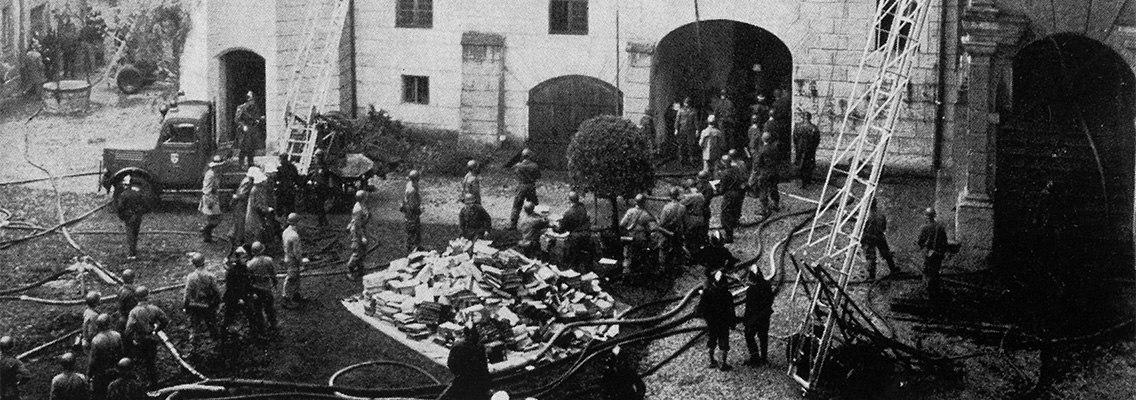
Floods, fires and other disasters pose an existential threat to archives, libraries, museums and other institutions that preserve cultural assets. Recent disasters and major incidents show that these threats are increasing rather than decreasing as a result of climate change. In order to avoid being left completely on their own in an emergency, cultural heritage institutions are joining together in emergency alliances. The participating institutions pledge mutual support within the scope of their capabilities in order to pool resources and ensure faster and more effective rescue and initial care of the affected archives, books and exhibits. An emergency agreement includes, among other things: joint training and exercises, the development of emergency plans, and ongoing professional exchange between those responsible and with external partners such as the fire brigade and the Technical Relief Service.
With the establishment of the Coburg Emergency Network, the Bavarian State Archives achieved their goal of establishing an emergency network at each of their archive locations in 2023.
Associations exist in:
-
Amberg-Sulzbach-Rosenberg (founded 2019)
-
Augsburg (founded 2015)
-
Coburg (founded 2023)
-
Bamberg (founded 2019)
-
Nuremberg (founded 2016)
-
Landshut (founded 2019)
-
Munich (founded 2016)
-
Würzburg (founded 2022)
Further information on the work of emergency networks in Germany can be found at:
The Coordination Office for the Preservation of Written Cultural Heritage (KEK) takes emergency preparedness into account in its funding guidelines and supports, among other things, the purchase of emergency boxes and other equipment or the development of emergency plans. An overview of projects funded to date in the area of emergency preparedness is available on the KEK website:
https://www.kek-spk.de/projektliste?term=notfall
The KEK website also provides an interactive overview map of all emergency networks in Germany:
https://www.kek-spk.de/notfallverbundkarte/#/
The Cultural Property Security Guide (SiLK) offers archives, libraries and museums a free online tool that enables them to assess the security level of their own institution and identify weaknesses in a self-evaluation:
The joint recommendations on emergency management in archives and libraries issued by the federal and state committees were revised in 2024 and are available here.
Emergency Framework Plan
In 2001, the General Directorate of the Bavarian State Archives drew up an emergency framework plan based not only on its own experience and new findings, as well as guidance from the emergency services, but also on the emergency plans of the Baden-Württemberg State Archives, the Westphalian Archives in Münster and the Thuringian University and State Library in Jena. Specifically, the emergency framework plan primarily contains a catalogue of recommendations for technical precautions and organisational measures to prevent or limit emergency-related damage to archive material, as well as instructions for emergency management (templates for procedure and alarm plans), immediate measures to rescue water-damaged archive material and follow-up measures.
The framework plan published here reflects the state of knowledge in 2001. A revision and update based on the experience and insights gained from the flood disaster of 2002 and the results of the ‘Emergency Preparedness’ working group of the Restoration Committee of the Federal and State Archive Administrations is planned.
Local emergency planning in the archives
Based on this framework plan, the Bavarian Main State Archive and the State Archives in Amberg, Augsburg, Bamberg, Coburg, Landshut, Munich, Nuremberg and Würzburg have developed their own emergency plans tailored to their individual structural conditions and requirements. As a first step, analyses of potential hazards were carried out in cooperation with the local hazard prevention authorities and the resulting preventive measures were initiated. In connection with the adaptation of the model procedure and alarm plan, contact was made with technical services, shipping companies and cold storage facilities as a precautionary measure, and their addresses and telephone numbers were recorded for use in an emergency.
For the evacuation of endangered or already damaged archive material, the archives drew up detailed rescue plans with priority lists and colour-coded rescue routes in the corresponding storage plans, or simply marked the doors to storage areas where important archive material is stored.
Emergency teams have been set up in each of the state archives, with the ‘mobile emergency team’ of the main state archive, which is mainly composed of employees from the preservation department, providing assistance to the emergency teams of the state archives when necessary. All archives now have emergency boxes containing basic equipment for emergencies, primarily protective equipment and aids and materials for the proper packaging of waterlogged archive materials. During a small emergency drill, the materials procured for the emergency boxes were tested for their practicality and functionality in the restoration workshop of the Bavarian Main State Archive. Using files and books that had been released for disposal and had previously been submerged in water for 24 hours, the packaging of water-damaged documents for deep-freezing and subsequent freeze-drying was practised. The aim was to avoid paralysing uncertainty in the event of a real emergency and to ensure quick and correct action. Staff training and fire drills have already taken place or are planned.