

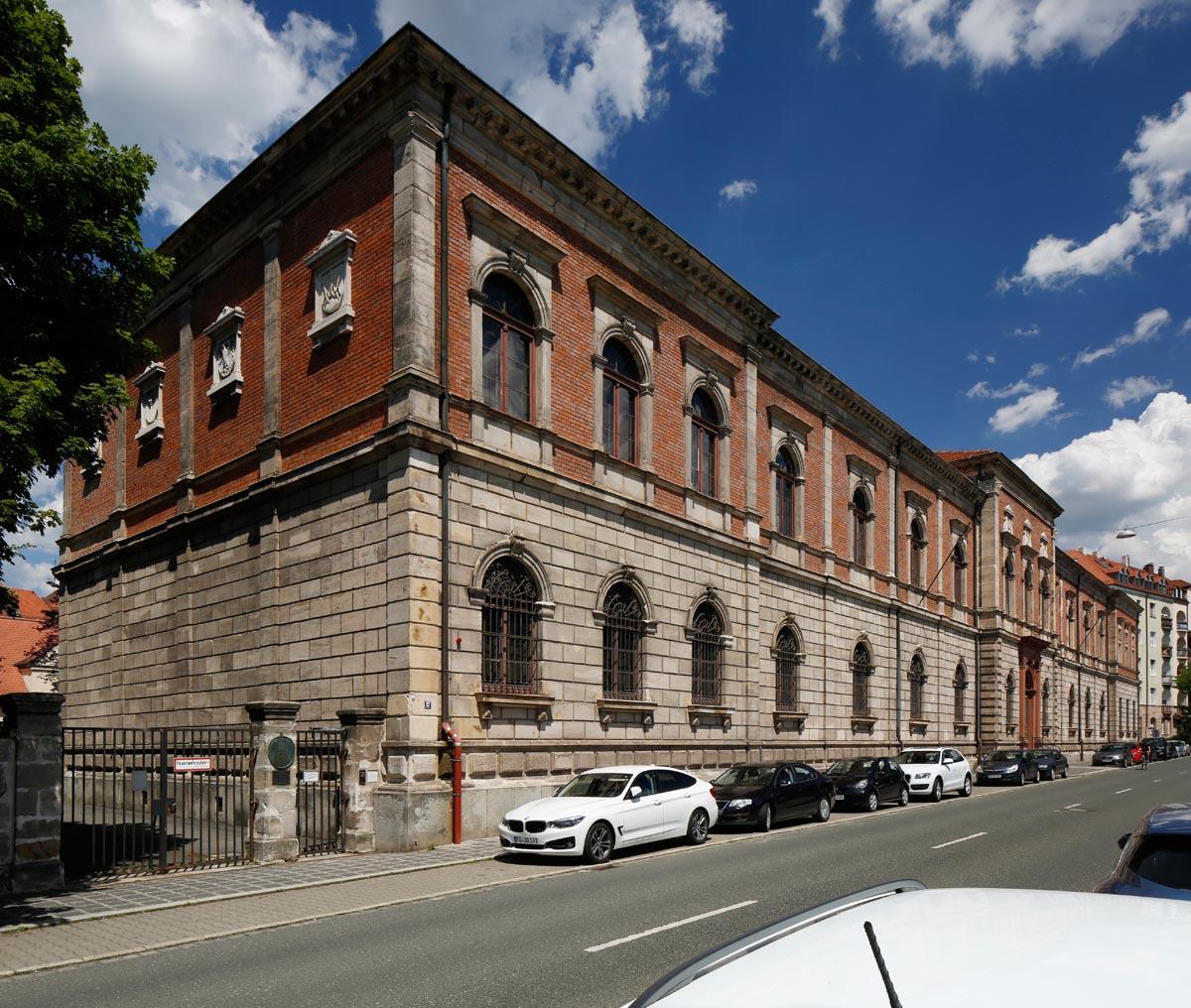
Rnovation work
The Archivstraße site is expected to undergo renovation until 2030. All holdings have been relocated. Since September 1, 2020, it has been possible to use the holdings at the relocation sites by making an appointment with the Nuremberg State Archives: Lichtenau branch near Ansbach Augsburg State Archives Landshut State Archives State Church Archives of the Evangelical Lutheran Church The staff of the Nuremberg State Archives can be contacted by mail, telephone, e-mail, or fax: Mailing address: Nuremberg State Archives, Rollnerstr. 14/4, 90408 Nuremberg Phone: 0911/935190 Fax: 0911/9351999 Email: poststelle@stanu.bayern.de PLEASE NOTE: Rollnerstraße only houses offices; it is not possible to use archive material there! For further information, please refer to the digital location overview [PDF file] >>>
Use and advice after prior registration
The number of jobs is limited. We therefore ask for a pre-registration. Please let us know when and how long you need the place. On Friday the reading room is open only in the morning
In the reading room of the Lichtenau office as well as in the reading rooms of the three evasive archives, users can also create digital photographs from archives.
Reproductions can be used with the form available for download for a Photo job be ordered.
Further information on the conditions can be found in the General
Use notes.
Head:Archive Director Dr. Daniel Burger
Sprengel: Government of Mittelfranken
Stocks:
- Formerly rich territories in the current administrative district of Mittelfranken as well as the former Franconian empire of Eichstätt. Main stocks and groups of stocks: Reichsstadt Nuremberg, Markgraftum Brandenburg-Ansbach, Hochstift and Domkapitel Eichstätt, kommens or Agencies of the German Order, parts of the archives of the Reichsstädt Rothenburg o.d.T., Weißenburg and Windsheim, Franconian Reichsritterschaft, Staats- und Adelsarchive (e.g. Crailsheim, Pappenheim, Schwarzenberg, Wrede).
- State central and lower authorities as well as courts in the central district of Mittelfranken from the beginning of the 19th Century.
- Writing of the so-called Nuremberg war criminal processes.
Scope: 37.660 lfm with approximately 8,47 million archiving units (as at 31. december 2024).
Virtual reading room:
Click here to access the virtual reading room of the Bavarian State Archives.
The State Archive Nuremberg is the state authority responsible for all questions of archives in the government district of Mittelfranken. As a historical detonator, he is located in the southern part of the Franconian Reich Circle and at the beginning of the 19th century. assigned to the Kingdom of Bavaria fallen territories whose government seats were located in the territory of the administrative district; the territorial reform of 1972 is not taken into account. These are in particular the Reichsstadt Nuremberg, the Principality (or Markgraftum) Brandenburg-Ansbach, the Hochstift Eichstätt and the largest part of the Ballei Franken of the German Order. The modern demolition was built in 1837 by the county of Mittelfranken in its current extension, modified by the 1972 territorial reform. With regard to the document of the Notariate since 1862, he has encompassed the territory of the Oberlandesgericht Nuremberg (Medium Franconia, Oberpfalz and the Lower Bavarian courts Kelheim and Straubing assigned to the local court Regensburg). It should be pointed out that the central and sub-authorities of such territories, which are located in today's archive raspberry, for whose central tradition a different archive is responsible, are stored there together with it (e.g. the brandenburg-bayreuthic main teams Erlangen and Neustadt a.d. Aisch with subordinate offices in the state archive Bamberg).
The state archive currently comprises approximately 7.3 million archive units (AE) (31 December 2013), including approximately 89,000 documents, 3,750.000 notariat certificates from 1862 and approx. 1,500 hand-drawn cards and plans before 1806. The total stock is approx. 38.200 meters (lfm).
The use depends on the usage order for the state archives of Bavaria of 16th. January 1990 (GVBl p. 6) in the valid version, in which the use fees are also regulated.
The State Archive (since 1970; 1806 Königlich Bayerisches Archiv, 1852 Archivkonservatorium, 1875 Kreisarchiv, 1921 Bayerisches Staatsarchiv) has emerged from the archive of the Reichsstadt Nuremberg, which fell to the Bavarian State in 1806.
For the time before 1806, the most important transfer agents are the Reichsstadt Nuremberg, the Principality of Brandenburg-Ansbach, the Hochstift Eichstätt, belonging to the Franconian Reichskreis (from the districts with the Residenzstadt 1972 came to the administrative district of Oberbayern), the German Orders, the smaller Reichsstädt (Rothenburg ob der Tauber, Weißenburg and Windsheim), the reign of Schwarzenberg and the rich For 19 and 20. It is the Bavarian State Authorities located in the Central Franconia district, as well as the federal and state authorities of the central and lower administrative levels.
In 1821/22, the Bavarian Archive Conservatory Ansbach was transferred to Nuremberg and combined with the existing archive. The former had emerged from the archives of the Principality of Brandenburg-Ansbach, which had recorded parts of the archives of the mediatized Reich cities Rothenburg ob der Tauber, Dinkelsbühl and Windsheim as well as smaller dominations and 1810/15 parts of the calibertic archive. In 1882/89, further calibertic central stocks, which had come to the archive in Neuburg a. d. Donau after the resolution of the archive conservatory Eichstätt in 1817, came to Nuremberg. In 1888 to 1909, archivals of rich-city-Nürnbergic provenance, in particular foundations (such as Heilig-Geist-Spital) and properties in the city, were handed over to the municipal archive Nuremberg, which was newly founded in 1864/65 (e.g. in exchange for archival materials on rich-city high-level rights and property ownership in the country). Due to timely outsourcing (at 36 locations), the state archive suffered hardly any losses during the Second World War. The increase in stocks due to the increasing number of government levies has forced the establishment of external offices since the 1960s. Since 1975, the conversion of the former Nürnberg fortress Lichtenau has been carried out for archive purposes, which was officially adopted as an external site in 1983. The increasing number of levies corresponds to a steadily increasing demand due to use since 1921 (proposed archives 1921: 3560, 2013: 18.300). The state archive has received its current stock profile through the stock purification carried out by Director-General Walter Jaroschka (1978 to 1997) between the state archives in Bavaria and Baden-Württemberg (see below C Vorbemerkung).
The ensemble, built in 1880 as the first archiving site of the Kingdom of Bavaria, is dominated by the Neorenaissance-style magazine building located on the archival street (East wing heavily damaged in the Second World War, reconstruction 1946–1954). The display façade decorate the coats of arms of the old territories lying in the explosive. The representative staircase (renovated in 1980) leads to a hall located above the Vestibül on the first floor. The office building (with office, technical and utility rooms), which is connected by a connecting passage, is located north of the warehouse, west of which the "Amtsdienerhaus" (1927) is built as a service apartment of the master house. In Lichtenau, in addition to office and utility rooms, there are also order rooms as well as magazines in the remote commander house (with two round towers). The upper floors of the five cavaliers and the inner wallbering are also developed as magazines.
An important task of the archives is to offer the documents entrusted to them in an external and internal order that meets the demands of administration and research. This is best done on the basis of the principle of provenance generally recognised today in Bavaria; the written material grown in an institution or private person is also left undivided in the archive in its context of origin or returned to it. In the case of the holdings from the period of the Old Reich it is a concern to observe the formation and structuring of the “secret archives” (as so-called archive provenance); because the old authorities' registrations from the transmission reached there can generally no longer be determined with satisfactory accuracy. Only on this basis can clearly defined, self-contained funds be created which also respect the validity of the written material (i.e. its hierarchical position). Within the funds, the document can then be developed and made accessible by the competence of the registrature (or archive) designer.
The aim of a clearly defined area of competence with regard to the historical archive raspberry is achieved according to the following measures: Return of the Ansbacher, Eichstätter, Nuremberger and Rothenburger tradition, which was moved from 1821 into the then General Reichsarchiv to Munich, in the years since 1938, repatriation of all documents before 1401 in 1992, release of the Munich German Order Stocks 1997. Conversely, the pfalz-Neuburgian holdings, which had been extracted to Nuremberg in 1912 and 1921 by the then circular archive Neuburg a. d. Donau according to the local subject principle, were submitted to the Bayerische Hauptstaatsarchiv. Purifications were also carried out with the State Archives of Augsburg (1990 issue of archives of the Reichsstadt Dinkelsbühl, located in the Swabian Reich district, as well as the former Wuerttemberg rule of Weiltingen) and the State Archive Bamberg (amberg, Reichsstadt Nuremberg). The State Archive Nuremberg receives, in particular, the 19th anniversary of a provenance-oriented stock exchange agreed between Bavaria and Baden-Württemberg. century after the local subject principle, archivals of Brandenburg-ansbachian stocks arrived there; Archives of the Stift Comburg (Amt Gebsattel) were submitted to the Staatsarchiv Ludwigsburg, archives of the mastery Mergentheim of the German Order will follow.
The development of levies, the formation of proving-oriented funds from the levies communities and the restoration of the registrature bodies of existing inventories in the transition period between the end of the Old Reich in 1806 and the establishment of governments as central authorities in 1817 (Generallandeskommissariat for Franken, Generalkreiskommissariate, etc.) are priority tasks.
In addition to the conventional founding aids in band form (for the old stock, in part, already since the 16th century). A series of maps (emigrants from the 19th/20th century) stand. Jh., death advertisements at the local courts). In the meantime, approximately 900,000 archiving units are recorded in the internal database system.
Publications about the Nuremberg State Archives can be found here.
Address
Rollnerstr. 14/4 90408 Nürnberg
Contact
Tel. 0911/935190 Fax 0911/9351999 E-Mail: poststelle@stanu.bayern.de
Management
Archive director Dr. Daniel Burger