

Closing
The reading room of the Augsburg State Archives will be open to users from 12 noon on Wednesday, March 4, 2026, due to an internal event.
Use and advice after prior registration
The number of jobs in the reading room is limited. We therefore ask for a pre-registration. Please let us know when and how long you need the place. On Friday the reading room is open only in the morning.
Finding means can be provided on request for research purposes in the reading room at the respective workplaces.
For preparation, you can find in the inventory overviews using the respective find book number in the reading room (email: readesaal@staau.bayern.de) order:
Due to human bottlenecks from 01.09.2018 in the Staatsarchiv Augsburg the number of available archives per user and user limited to six. There is the possibility of written or telephone preorders (to be addressed 24 hours before the visit):
E-mail: readesaal@staau.bayern.deinsofar as signature is known; i.d.F. Template of the first archives at 8:00.
It is also pointed out that delays can occur in the processing times of reproduction orders.
In the reading room of the Staatsarchiv Augsburg can Users also create digital photographs from archives. This requires the signing of a corresponding declaration and compliance with the rules laid down therein. For legal and conservative reasons Not permitted are:
- Archives whose maturity date is less than 100 years (exception: basic tax catasters may be photographed without time limitation)
- Archives of which digitalisates already exist
- Official books and bound files that cannot be opened to 120° without any problems
- Archives with mechanical damage
- Archives with overformat (larger than the usable table area)
Head: Archive Director Dr. Thomas Engelke M.A.
Sprengel: Government district Schwaben
Stocks:
- Territories and Institutions of the former Swabian Reich Circle and Front Austria, at the beginning of the 19th century They have fallen to Bavaria (e.g. Hochstift and Domkapitel Augsburg, Fürststift Kempten, numerous pens and monasteries, Vorderösterreich, Reichsstädt, noble families and rulers).
- State central and sub-authorities as well as courts in the district of Schwaben from the beginning of the 19th century Century.
Volume: 27.552 lfm. with approximately 3,27 million archive units (as at 31. December 2024).
Transport: Tram Line 3 from Central Station to the south in the direction of Inninger Straße to the stop University, driving time about 15 minutes.
Virtual reading room
Click here to access the virtual reading room of the Bavarian State Archives.
The State Archive Augsburg is the state archive responsible for the Bavarian government district of Schwaben as a specialist authority for all questions of archives. As a historical detonator, the territories and institutions of the Swabian Reich Circle and the Front of Austria are assigned to him. They fell to Bavaria for centuries.
The state archive currently comprises some 2.9 million archive units (as at 31.12.2006), with a total volume of nearly 20,900 lfm, including approximately 88,400 documents, 131,000 official books and approximately 16,400 lfm files. Modern stocks are continuously supplemented by the levies of authorities, courts and other public bodies of the Free State of Bavaria in the field of competence.
The use is governed by the use order for the state archives of Bavaria dated 16.1.1990 (GVBl p. 6), in which the use fees are also regulated.
The State Archive Augsburg is the successor of the former state archive Neuburg a.d. Donau, which was transferred to the government capital of Schwaben in autumn 1989.
Neuburg a.d. Danube was originally the centre of the small principality of a Wittelsbach-Pälzian side line, from whose second prince, Pfalzgraf Wolfgang (+ 1569), the current lines of the house Wittelsbach originate. The city was therefore since 1505 until the beginning of the 19th century. The headquarters of the Pfalz-Neuburgische Archiv (with important parts of the archives of Bayern-Ingolstadt and especially of Bayern-Landshut) and, even after the abolition of the province of Neuburg in the newly-organized Kingdom of Bavaria (1808), maintained an archive (archive conservatory and a depot registration).
In 1830, the depot registrature, which was initially subordinate to the government of the Oberdonaukreis in Augsburg, took stock, which until then in archive conservatories or Depot registrations for Dillingen a.d. Donau and Kempten (Allgäu). These were the remnants of those archives or parts of archives at the beginning of 19. century by secularization and mediatization of spiritual and secular states and institutions in the area of the later Bavarian government district Schwaben to the Kurfürstentum or later Kingdom of Bavaria had passed; according to a division of their holdings in – in the opinion of that time – “archival documents” (descripts, valuable official books and specially selected files) and in “non-archival documents” the first was to Kgl after 1812. Bayerische Allgemeine Reichsarchiv (later: Bayerisches Hauptstaatsarchiv) was transferred to Munich while the rest remained on site.
Since the technical submission under the General Reichsarchiv in Munich (1837), this circular depot registration could be detached from the role of an altact repositur and could enrich its holdings by public authorities. The excretion activity continued for decades over areas of the former Principality of Pfalz-Neuburg and of the province of Neuburg (with parts of the former Hochstift Eichstätt) and was only oriented since 1882/85, at the same time as the breakthrough of the local pertinence principle, to the administrative boundaries of the district Schwaben and Neuburg (the name particles reminiscent of the province of Neuburg). In 1841 officially named “Archiveskonservatorium”, the office has been named “Kreisarchiv” since 1876 in order to become the Bavarian State Archive Neuburg a.d. Donau in 1921.
The Neuburg archives, which had taken place before the association of the depot registratures of 1830, had made it possible for the Neuburg archives to become an annex of the Old Bavarian archive landscape, since the General Reichsarchiv also took up all early and high-medium-age as well as all “archival” tradition, i.e. especially all documents, from the Bayerisch Schwabens area. In 1924, the concept of a clearer task cut, which also had an eye on the combination of torn stocks, brought about the release of almost all archives from the largest historical territories of the archival raisin, namely the high foundation of Augsburg and the prince foundation Kempten, to the Bayerische Hauptstaatsarchiv (“Neuburger Spendn” for the distinction of those already at the beginning of the 19th century. “Munich collections” acquired into the Reichsarchiv. Not consistently continued and partially reversed, these measures ultimately increased the stock thickness.
During the Second World War and in the immediate post-war period, the Neuburg archives, partly outsourced from the castle building, did not take any significant damage. However, the more and more difficult conditions of space in the service building which did not meet the modern storage criteria have become a reason to pursue previous plans for laying to Augsburg since 1965. Another argument was Neuburg's ever-given marginal position in the modern archivists, which became formal exterritoriality with the territorial reform of 1972. The establishment of the Swabian national university in Augsburg (1970) finally gave a decisive impulse for the transfer to Augsburg. At the same time, the State Archive received a new stock profile on the basis of the Bavarian constituents of the Swabian Reich Circle. Its responsibility for growing stocks extends to the government district of Schwaben in its respective valid limits.
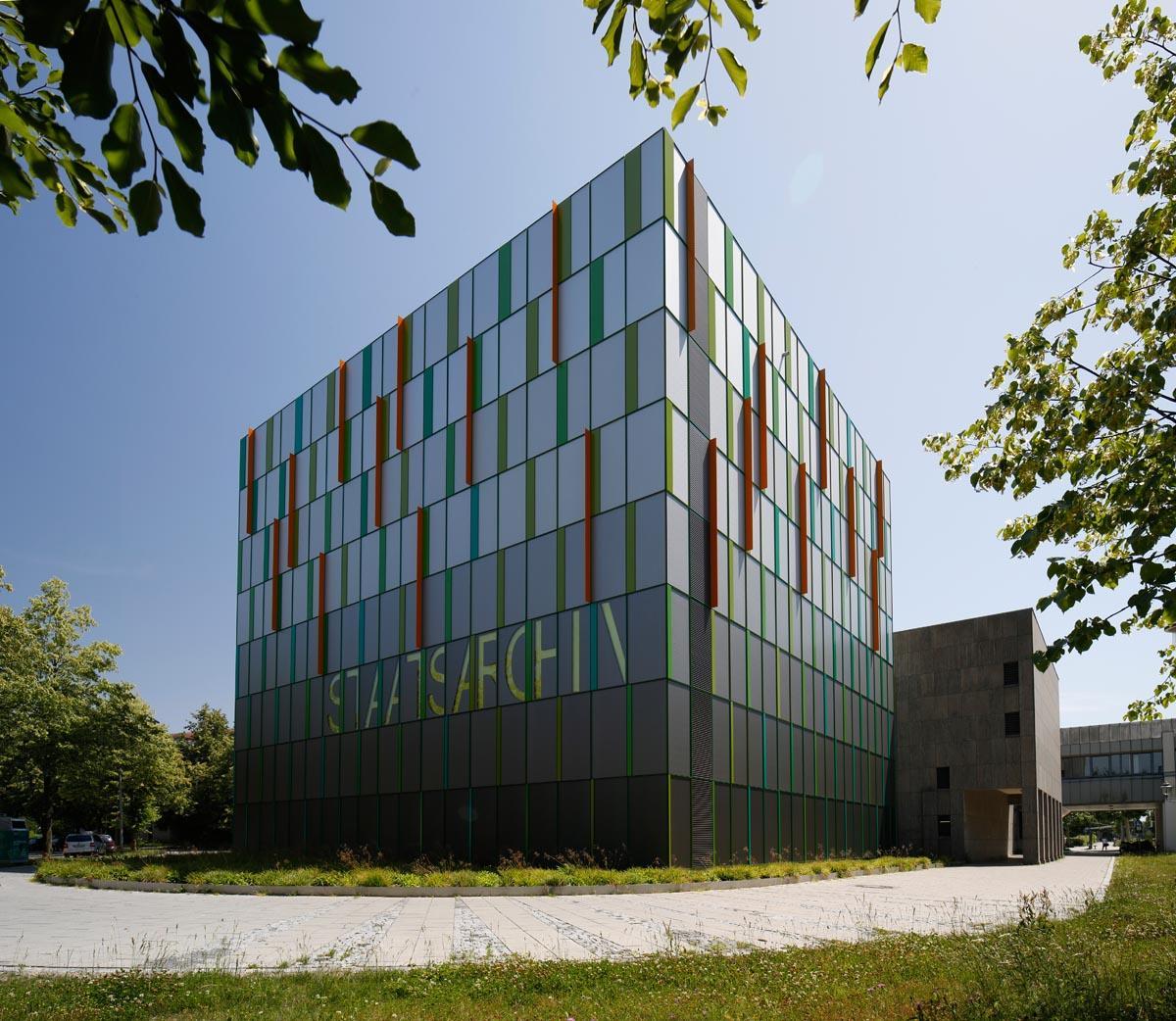
Since autumn 1989, the State Archive has been housed in an archive-purpose building, which was already planned in a urban planning idea competition from 1974 on the grounds of the former Augsburg airfield – in the transition area between (new) university and densified urban housing – in a central octagonal place. The architectural competition (1979/80) was won by the Augsburg architect Hans Schrammel, according to whose plans and under the direction of the Land and University Building Office Augsburg the new building was built in 1985/89.
This new building is architecturally determined by the location at the central square. It is divided into two structures set parallel to each other: into the two-storey administrative building (with the user area on the ground floor) into the square and behind it, separated by courtyards and at the same time connected by two staircase towers (with elevators), the four-storey magazine building (EG with delivery area and three OG). The magazine as the core piece of the new state archive was designed according to the so-called Cologne model: the 50 cm thick brick walls (with a few narrow window openings) which are only plastered inside are provided with a rear-ventilated shell of shell lime plates. This results in a constant room climate in the twelve magazine sections, which are almost continuously equipped with roller shelves, which is controlled manually only by transverse ventilation or by slight heating in the cold season, supported by automatic temperature and humidity meters.
The entrance area at the central square with a curved glass-metal façade and a generous entrance hall is emphasized by a surrealistic-manieristic plastic ARCHIVA 87 by Jürgen Goertz, Eichtersheim: On a slightly sewn and thus an incidental stone base sits a stamp-like bronze head, half as a man and half as a woman, with a laid-on knowledge on the ball. The scale applied to the support through which this connection is guided indicates the time whose preciousness is additionally emphasized by an above-set egg made of stone.
A spacious, light reading room with 30 workstations and seven working cabins with natural exposure and ventilation are available to the archive users. The public sector includes a combined lecture and exhibition space, which is also used for courses.
The state archive Augsburg differs significantly from the state archive Neuburg in terms of its structure and focus. With the transfer of provenance-adjusted stocks of territories of the Swabian Reich Circle and of the Austrian suburbs from the Bavarian Main State Archive in the years 1990–1992, the framework of responsibility of the State Archive was implemented with regard to its historical explosive. A demarcation, which is oriented towards the Reichskreis classification, was also carried out to a smaller extent with the State Archive Nuremberg (among others Reichsstadt Dinkelsbühl, today Mittelfranken). At the same time, the transfer of pfalz-Neuburgic central offices to the Bavarian Main State Archive was submitted.
Particular importance is now given to the internal assembly of the traditions previously distributed to different archives, and, if possible, to the restoration of the original archives and registrature bodies of the inventors who have fallen under the years 1802/08. The principle of provenance, with the release of previously spilled relationships, becomes the means of development in territories with initially confusing legal relations.
A presence of around 25,000 volumes is available to the users, where Swabian and Bavarian history and the history of neighbouring countries and regions are thematic priorities.
Documentation on contemporary history includes annual reports of secondary schools (from 1808/09) as well as official and communication sheets of municipalities and secondary authorities. A collection of writings by the parties, associations and associations created in 1976, as well as from the church and private sector (including numerous anniversary celebrations) in Schwaben extends until the year 2000.
Publications about the Augsburg State Archives can be found here.
Invitation to membership
The Friendship of the Swabian State Archive was founded in Augsburg in June 2000. He is recognized as non-profit. The circle of friends has, among other things, become a task,
– to promote the initiatives of the State Archives of Augsburg in the field of Swabian history, to unlock the holdings of the “Schatzhaus der schwäbischen Geschichte”;
– to improve the collection of the State Archives, to guide all friends of Swabian history through publications, conferences and lectures the great importance of historical information in the State Archive
– and to assist in securing municipal and private archives in the government district of Schwaben.
What are the benefits of membership?
Through their membership, the members not only support the activity of the state archive materially and ideally, they also receive selected publications of the state archive administration at a special price in addition to an annual presentation. Members are invited to all events of the State Archive.
What does an annual membership cost?
Membership costs 15,00 EURO for individuals, for legal persons and associations of persons 130,00 EURO. If you want to support our goals, please send the application to us or submit it to the State Archive Augsburg. You will then receive further information. We are looking forward to your membership.
How do I become a member?
If you would like to join the Association of the Friends of the Swabian State Archvis, please fill out the form you wish to receive Download here (PDF flyer with registration form) can and send it filled by mail to the address below.
The Societas Amicorum statutes can be found here (PDF file for download).
Address:
Circle of Friends of the Swabian State Archive
c/o State Archive Augsburg
Salomon-Idler-Str. 2
86159 Augsburg
Account number of the circle of friends:
23002 Stadtsparkasse Augsburg (BLZ 720 500 00)
Address
Salomon-Idler-Str. 2 86159 Augsburg
Contact
Tel. 0821/599 63-30 Fax 0821/599 63-333 E-Mail: poststelle@staau.bayern.de
Management
Archive director Dr. Thomas Engelke M.A.